info@karmickinstitute.com
 +919836423755
  +919836423755
Get up to 25% OFF on all IT courses Enrol Now Only 20 Slots Remaining! Limited Time Offer!
Can non-technical students learn digital marketing? Absolutely! Let’s bust a big myth right now. You do not need to be a coder or an expert to build a career in digital marketing because this field is more about psychology, not technology.
Today, digital marketing is one of the most accessible industries for non-tech learners. While the industry uses tools and digital marketing channels, the core of marketing will always be about understanding human behaviour and communicating with them effectively.
Furthermore, up to 85% of repetitive, technical marketing tasks can now be assisted by AI tools. This allows creative, non-technical people an equal chance to build a career in digital marketing.
The global digital advertising is expected to touch $786.2 billion by the end of 2026, meaning the demand for this talent isn’t going to slow down. The best part is, you don’t need technical knowledge to break into this field.
In this blog, we will break down exactly how you can leverage your non-technical skills to start a successful career in digital marketing.
If you read the definition of digital marketing online, you might get overwhelmed with the amount of jargon used in the sentence. Let’s cut the complexities and get straight to the point.
Digital marketing is all about simply meeting people where they spend most of their time, i.e. on the internet. Let’s talk about your daily routine: you check Instagram, read product reviews on Google, watch a video on YouTube, check your mail, or read a blog online. Here, digital marketing is reaching you on all these platforms to grab your attention, tell a story, or solve a problem.
Digital marketing isn’t about mastering the technology itself; it’s about mastering how to communicate through the technology. This field generally breaks down into a few core areas:
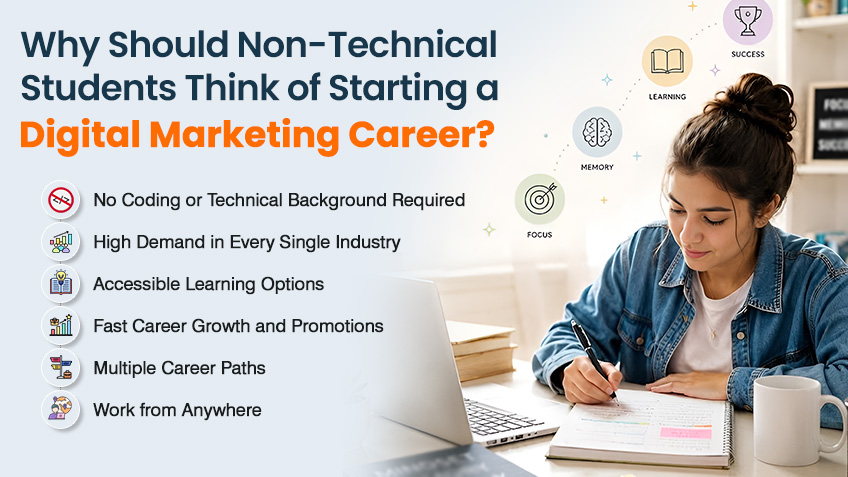
Whether you studied history, literature, psychology, business, or job-oriented courses after BA (Arts), the job market can sometimes feel intimidating, especially when tech roles mostly dominate the news headlines. The good news is that digital marketing is one of the high-growth industries that welcomes people with creativity, communication, and empathy.
Here is a detailed breakdown of why a digital marketing career is a top skill for non-technical students.
You do not need a computer science degree or programming skills to succeed in digital marketing. The daily tools used for social media, email campaigns, and content creation are designed to be user-friendly and easy for anyone to learn.
From fashion brands and sports to hospitals and tech startups, every business needs a robust online presence to survive. This massive demand means there are always plenty of job opportunities available in digital marketing, no matter what your background is.
You don’t need to go back to college to build a digital marketing career. Anyone can learn fundamentals and build a strong foundation through high-quality training and Vishlesan I-Hub, IIT Patna certified Digital Marketing with AI course offered by Karmick Institute.
In digital marketing, your success is measured by your results, not by how many years you have sat at a desk. If you can create a post or an ad that brings in sales, managers will notice immediately, allowing you to get promotions and raises quickly.
Digital marketing offers a huge variety of roles. If you love visuals, you can build your career in social media marketing; if you love writing, you can become a content writer and do blogging; and if you are good at management, you can handle influencer partnerships.
Since all your work is done on the internet, you can work from any part of the world. As long as you have a laptop and a steady Wi-Fi connection, you can easily work from home, a coffee shop, or even while travelling.
How much time does it take to learn digital marketing for a non-technical student? The short answer is between 3 and 6 months. However, the exact timeline entirely depends on how much time you commit every day and how you are going to learn it.
Here is a realistic breakdown of what your journey will look like:
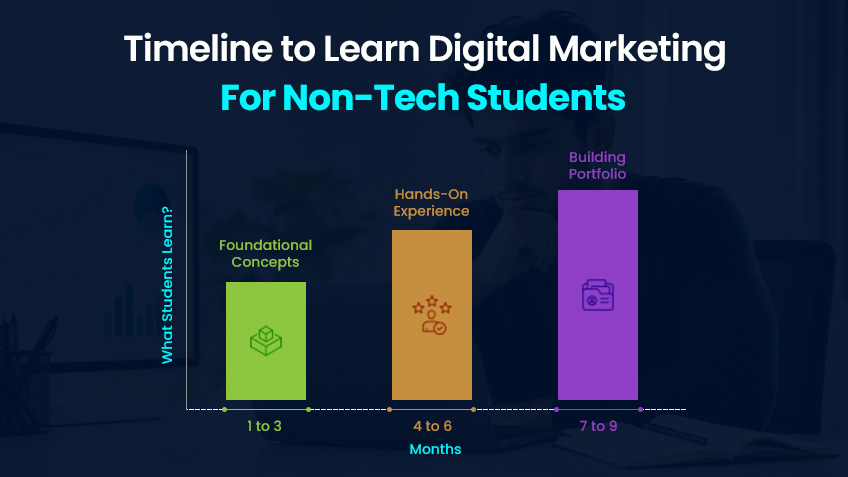
Starting with mastering foundational concepts like SEO and algorithms, your journey takes about 3 to 6 months. In months 2 and 3, you’ll gain hands-on experience, and in months 4 to 6, you will build a practical portfolio through internships or test campaigns to prove your skills to employers.
Your timeline depends on your specialisation, weekly study hours, and how quickly you practice. Creative paths like social media management take just 2 to 3 months, while becoming a Google Ads expert can take up to 6 months. Dedicating a consistent 10 hours a week to practising with tools like Canva and Mailchimp will drastically speed up your progress.
AI has officially cut the marketing learning curve by almost 50% as it handles technicalities like data formatting, coding, and basic copywriting. Learning AI in digital marketing allows you to 100% of your energy on human strategy, psychology, and creative execution.
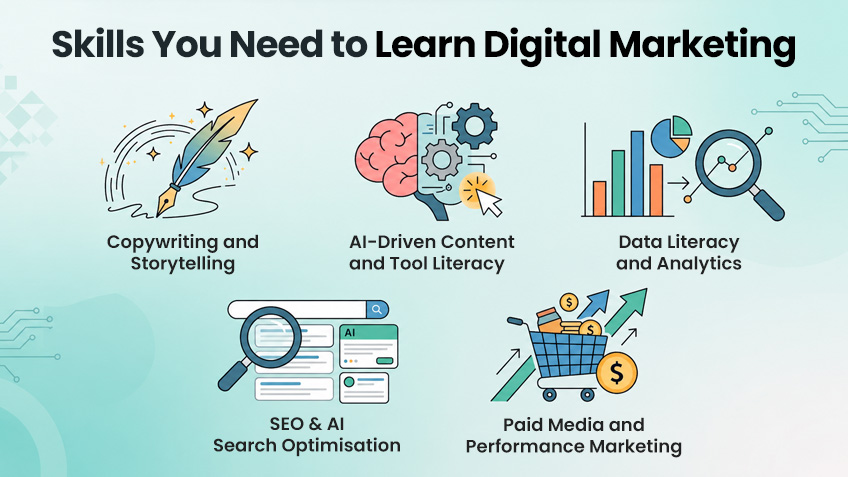
You need to learn how to write short, catchy ad text, engaging social media captions, and interesting blog articles that instantly connect with human emotions and drive sales.
Although you do not need to code, you must know how to use modern tech. Focus on learning how to guide AI tools (like ChatGPT or Jasper) for brainstorming, master design apps like Canva, and navigate automated email systems like HubSpot.
You don’t need to be a math genius in digital marketing, but you do need to understand basic data. You must learn how to look at dashboards like Google Analytics 4 (GA4) to know how many people are visiting a website, what they are clicking on, and why.
SEO is the art of making a website appear at the top of Google for free. As search evolves from SEO to GEO, you need to learn how to research the keywords people type into search bars and how to structure your content to get picked by both Google and AI search assistants.
You need to learn how to navigate ad dashboards on platforms like Meta (Instagram/Facebook) and Google Ads, specifically how to set a budget, target a specific audience, and track if those ads are making a profit.
Pro-Tip for Beginners: Don’t try to master all five skills at the same time. Pick one that matches your personality (like copywriting if you love writing, or paid media if you like strategy), master it first to land your first job, and then slowly learn the rest as you grow.
| Career Level | Job Roles | Average Salary Range (Per Annum) |
| Entry-Level (0 – 2 Years) | Digital Marketing ExecutiveSEO ExecutiveSocial Media Coordinator | ₹2.5 Lakh – ₹4.5 Lakh |
| Mid-Level (2 – 5 Years) | Senior ExecutivePerformance MarketerContent Specialist | ₹5 Lakh – ₹10 Lakh |
| Senior-Level (5 – 8 Years) | Digital Marketing ManagerBrand ManagerCampaign Lead | ₹10 Lakh – ₹18 Lakh |
| Leadership Level (8 – 12 Years) | Head of Digital MarketingVP of Marketing | ₹18 Lakh – ₹30 Lakh |
| High Level (12+ Years) | Chief Marketing Officer (CMO)Digital Marketing Director | ₹30 Lakh – ₹50 Lakh+ |
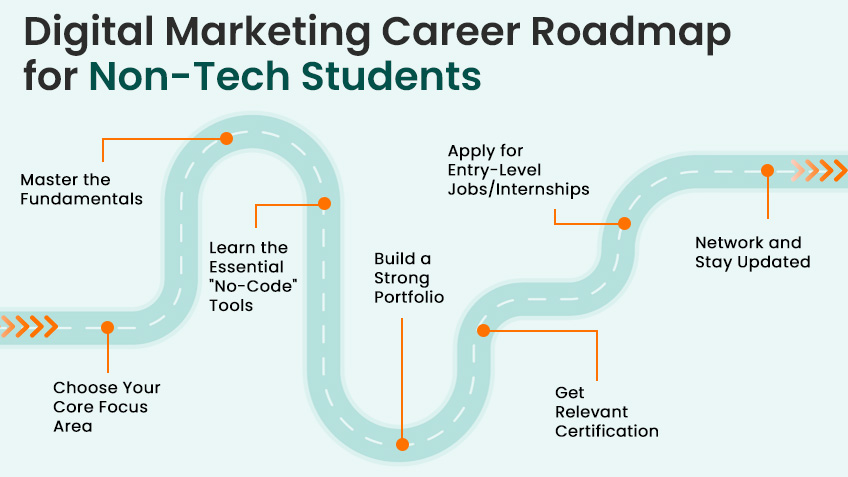
As digital marketing is a huge field that consists of many different roles, trying to learn everything at once can be overwhelming. Consider picking one path that aligns with your strengths. For example, choose content/SEO if you have an interest in writing, social media if you are creative, or paid Ads (Performance Marketing) if you like business strategy.
Before learning complex strategies, you need to understand how the online business functions. Learn how a standard marketing funnel works, specifically how a stranger discovers a brand, becomes a follower, and eventually turns into a paying customer.
Modern marketing heavily depends on user-friendly software that requires absolutely zero coding skills. Consider dedicating time to mastering these tools. Learn Canva for visual design, experiment with AI tools like ChatGPT for copywriting, and get familiar with email platforms like Mailchimp or HubSpot.
In this industry, proving you can do the work matters much more than your college degree. Build real experience by working on a blog, a social media page, or a local business, and use that work as your portfolio.
If you want to stand out from the crowd even faster, consider a professional program like the Advanced Digital Marketing Course with AI at Karmick Institute. We offer premium, blended training (online/offline) with industry-recognised Vishlesan I-Hub, IIT Patna certification. Through hands-on training on cutting-edge AI tools and 100% placement support, we ensure you land a high-paying job in just 6 months.
The best way to learn is on the job. Start applying for beginner-friendly roles like “Digital Marketing Intern” or “SEO Fresher” as many companies actively look for enthusiastic freshers they can train from scratch.
Digital marketing trends and algorithms change rapidly. Here, making a habit of continuous learning is a necessity. Build a professional LinkedIn profile to connect with experienced marketers, join active marketing communities, and read industry newsletters to stay ahead of the curve.
Pro Tip for Beginners: Don’t wait until you feel “100% ready” to start applying for internships or entry-level roles. In digital marketing, 80% of your actual learning happens on the job while working on real business problems.
By now, it must be clear to you that your non-technical background is not a barrier but an advantage in building a digital marketing career.
With the right guidance, consistent practice, and a recognised certification, you can go from a complete beginner to a confident, job-ready digital marketer in just 6 months. There are huge opportunities wide open for you; all you need to do is to take the right first step.
Call us today! 9836423755 | 6289562294 | 8910945693
Is digital marketing non-technical?
Yes, digital marketing is non-technical. While it uses digital tools and platforms, it relies heavily on human psychology, creative storytelling, writing, and communication rather than coding.
Is digital marketing a good career option for non-technical students?
Absolutely! Digital marketing is one of the best fields for non-technical students right now. Businesses of every size need people who can run ads, manage social media, write content, and grow their online presence. The demand is huge and only growing.
What academic stream is best suited for digital marketing?
There’s no best stream for digital marketing because it suits all. Whether you are a student from Arts, Commerce, or even Science, your skills and portfolio matter more than your degree.
What is the starting salary for digital marketing freshers in India?
In India, digital marketing freshers can start their career with a salary between ₹2.5 and ₹4 LPA, depending on the city, company, and the skills they bring. If you have strong practical skills or certifications, you can climb the ladder faster, even as a fresher.
Can BA and B.Com students get jobs in digital marketing?
Absolutely! B.Com students excel in analytical roles like paid Ads and e-commerce marketing, while BA students often thrive in creative roles like content writing, SEO, and social media management.
How long does it take to learn digital marketing for non-IT students?
You can learn digital marketing in about 3 to 6 months with a focused course and hands-on practice. The key is to gain practical experience in running campaigns, managing pages, and building real projects while you learn.
Which digital marketing channels are easiest to learn for non-technical beginners?
Social media marketing (SMM) and content marketing/copywriting are the easiest entry points, as they rely on apps like Instagram or LinkedIn and give more significance to your natural writing and creative skills over data and analytics.
What are the best career options for someone with a non-tech background?
There are plenty of great paths for students with a non-tech background, such as a content writer, social media manager, performance marketer, SEO executive, email marketer, influencer manager, or even a digital marketing analyst. As you grow, you can move into strategy and brand management roles too.
Does a non-technical student need to know coding for digital marketing?
No, you do not need to write a single line of code. Whether it is Canva for graphics, Mailchimp for emails, or ChatGPT for brainstorming, all the daily software you will use is entirely “no-code” and user-friendly.
What jobs can non-technical digital marketers get?
You can easily land roles such as social media executive, content writer, SEO specialist, influencer marketing coordinator, or digital marketing associate right after learning the basics.

Tanmay Das is a Digital Marketing Expert & Karmick Institute faculty specializing in SEO, Google Ads, Meta Ads, Analytics, and growth-driven marketing.


 Login
Login