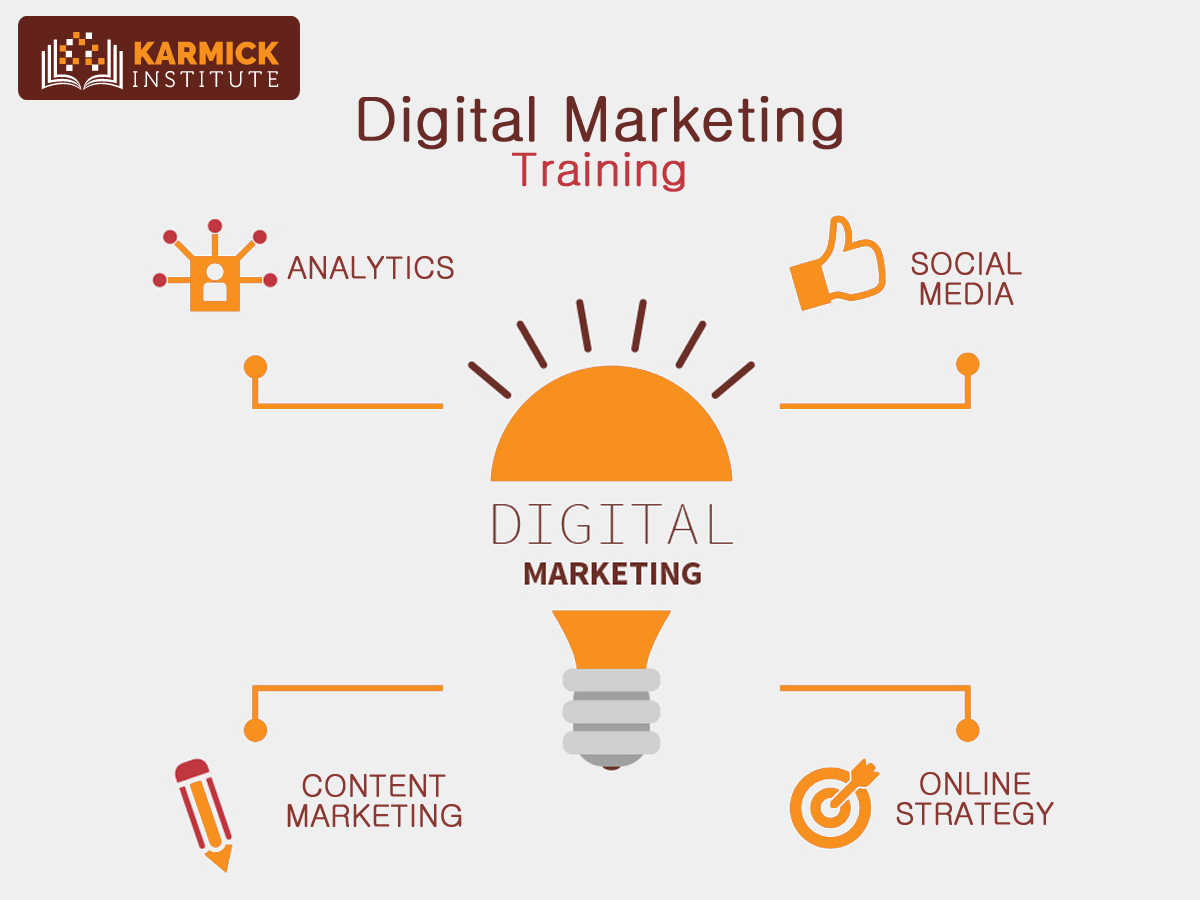
Irrespective of the size of business, everyone is trying to survive in the world of business. Marketing of a business is an age-old concept. But with time and preference, it has come to a far extent and now digital marketing concept is a rage compared to traditional way of marketing. The strategies of digital marketing are very effective to capture the online marketplace. May your website receive lots of traffic, but it is not compulsory that the leads will convert into sales. There is the actual difference between a failed business and a successful business. Digital marketing Course Kolkata can be a game changer for you to survive in the tough competition and achieve growth of the business.
Today, digital marketing professionals are contributing towards growth of online sales in various ways. Let’s spill the bean and put some light on how these professionals are helping in the growth of the business and help the business owners to gain profit from the products and services:
The professionals play the real game to bring the small companies into the limelight and give a chance to fight with big names and help to achieve the required traffic. Digital Marketing Training Institute prepares the students in such a way that as professionals they can take up all the involved challenges and help the business organization to stand out in the crowd.
Digital professionals understand the actual purpose of the website business and accordingly take online measures to convert the leads to sales. Hence, conversion is an essential for the marketing effort. Conversion optimization plays a pivotal role for the business owners and it becomes the top priority of the business.
Digital Marketing Course Kolkata is designed in such a manner that when a DM professional implements the knowledge in the practical field, then it turns out to be the best digital marketing technique for the particular business. These techniques used by a professional in digital marketing will generate high revenue of the business in the long run.
For a professional, it is not only the business website that they focus on, but they focus on the target audience. The internet platform gives diverse interaction facility to capture target audience of a particular business.
The website owners are looking for certified DM professionals to enhance their business growth and desire to survive in the business world. They want dedicated, smart and active professionals who can solve a marketing problem in a jiffy.
Looking at the growing demand of digital marketing scenario, Karmick Institute also started a 3-month Digital Marketing Course Kolkata so that potential candidates can turn out to be responsible digital marketing professionals. To get admission in a Digital Marketing Training Institute, the students have to pass 10+2 or can be a Graduate.
What are you waiting for? If you love to spend time online, then why don’t you take admission in this course and change the concept of business marketing strategies. After all, you are the future of today’s digital world.
Whether it is a homeowner looking for a full-time maid or a professional looking for an online course on big data, the dependency on the web to find anything has become phenomenal. According to Statista, it is estimated that there will be more than 650 million internet users in India by 2023. Even 32% of businesses in India now have a digital presence, and the number is expected to grow exponentially.
In such a scenario, there is a golden opportunity for people who have the knowledge and skillset to develop, implement, and manage effective marketing campaigns within the digital space. So, if you are someone looking for a lucrative job in 2020, pursuing a digital marketing course can help you! Let’s know the top reasons for which digital marketing will be a leading career in 2020.
A shift from traditional marketing
Today, one can search and buy almost everything over the web. Gone are the days when businesses use to prefer door-to-door marketing. Buyers want everything on their fingertips. The penetration of mobile devices had added fuel to this changing trend in marketing. This tectonic shift from traditional marketing is providing ample scope for digital marketing professionals.
Digital India initiative by Government
The digital India initiative that was launched by the Government of India on July 1, 2015, has given rise to new business opportunities in a more connected India. This, in turn, has helped plenty of small businesses to have a digital presence. They are now eager to promote their products or services in the digital space for which they, of course, need skilled digital marketers.
Better engagement with customers
The increased penetration of mobile devices and the growing number of internet users have generated new ways of engagement with customers or clients. Today, it is a proven fact proved that there is better engagement by implementing digital marketing tactics such as blog posting, social media posts, and more. There is a drastic increase in content consumption fuelled by affordable data plans and cheaper smartphones.
Moreover, after completing a digital marketing course, you can easily find a job as a digital marketing strategist or a social media manager. You can also work as a freelance digital marketing professional or can become a full-time You Tuber to earn money. So, just go ahead and enroll yourself in a digital marketing course from a reputed training institute that offers quality training and be ready to have a flourishing career ahead!
One of the most popular areas that are in demand in the IT companies is those of mobile application developers. With iPhone, Samsung and other tabs and smart phones launching applications that aims to make an individual’s life easy and effortless, in turn in creating huge job opportunities in this domain. As this genre has really developed in the last decade, the job sector si still not saturated, as such there is a huge opening. So if you are one of those who not only loves to possess a smart phone but be responsible for how these apps work, get admitted to a mobile application course where you will be taught all the tricks of the trade. As it is a highly creative field, you can make you of your creative bent of mind so that you can easily meet the ever growing demands of clients.
Did you ever think that you will be able to check weather, maps and play games and do all your other activities through a simple medium called phone, that was discovered so that one person can talk to the other person? Each passing day, the whole concept and scenario is getting changed, so be a part of this change rather than watching it with an awe struck expression and an open mouth.
But like all things that are different from others, here too you need to have the basic skill and expertise. So what do you do for this? Get in touch with Karmick Institute and get enrolled in their Android application course. This is one of the leading android apps development training courses where you can learn all the tricks and skills that will help you champion this genre.
As one of the leading institute in Mobile Application Training kolkata, Karmick Institute has modeled their course in such a manner that it easily meets the growing demands of the IT companies. Their 4 months course, with flexible timing consists of:
In the software industry, mobile development is at present one of the fastest-growing domains. It is full of opportunities, and one can also earn money as a freelance app developer. There are millions of people in India who work as mobile app developers and earn decent money. So, are you also an aspiring mobile app developer? Are you confused about which one you should learn for your future career? If yes, here are the few factors that you must keep in mind to make an informed decision.
Market share
Android, iOS, and Windows are the operating systems that rule the market. As per Statista, Android enjoys a share of over 95% followed by Apple’s iOS, which has just a 3.2 % market share in India. So, no doubt enrolling yourself in an android app development course makes more sense if you are targeting only the Indian audience. Here, you have to keep in mind that if you want to target people in the United States, it is best to learn iOS app development as in the U.S as iPhones are much more common than Android devices.
Time to learn
If you are a newbie with no prior experience in mobile app development, it will take some time to get familiar with new technologies. However, both have a different set of complexities, and hence, the learning time may differ. For iOS app development, you need to learn swift as it is the most popular programming language after Objective C for developing ios apps. Now, the learning curve for Swift is not steep, which means you can learn it quickly. If Android app development is considered, several programming languages are used in the industry, such as Java, C#, Python, Kotlin, and C++. So, you can learn any of these languages as per your learning capability.
Hardware requirements
For developing ios apps, you must have a Mac computer that runs the latest version of Xcode. Now, Xcode is Apple’s integrated development environment (IDE). It is a pre-requisite for developing any software for ios devices. On the other hand, you need to have a computer running on any operating system for developing android apps. So, mobile app development for android devices is the best course of action.
Development tools
The availability of development tools has a profound impact on mobile app development. While the Android platform offers Android Studio, its official IDE for mobile app development, the ios offers the Xcode IDE as told before. Although Android Studio has attractive features that help in app development, it is not considered as good as the Xcode. So, if you consider the availability of development tools, ios app development seems a better option.
Monetization
If you are getting into the app development business to make monetize them and earn decent revenue, you have to be quite careful about choosing the right platform. It has been found that ios users are more likely to make a payment for an app in comparison to Android app users. So, if you can sacrifice the revenue, go for android app development or else choose the one that guarantees more money.
Documentation
The platform that has more clear document is usually the one in which app development become easier for beginners. While many ardent admirers of the Android platform may disagree but the ios community and documentation are more helpful. As a developer, you may quickly found ways to solve a problem if you come across any during developing your app.
Publishing
Publishing an android app on Google Play is fairly an easy affair. You have to just pay a one-time fee of $20, and then Google will scoop up a whopping 35% of the revenue (if any). You will have the right to distribute it wherever you want, but things are not that simple if you are want to publish your ios app development. First, you have to publish it only through the Apple App Store. Next, you have to pay a fee of $99 a year, and here like Google, Apple will scoop up 30% of the revenue ( if any). If these are not enough, you will be not eligible to distribute it freely as per your wish as Apple has a more restrictive policy regarding app distribution.
So, think about all the factors and make a decision. You may find ios app development more enjoyable in the beginning. However, your android smartphone in your pocket may encourage you to first go for an android app development course that you can test easily. However, there is no point in comparing the two as your preference matters the most. If you already have a Mac, you must go for an ios app development course without having any second thoughts. There is no shortage of mobile app development training institutes in Kolkata that are offering online classes in the wake of COVID-19.
“UI is the saddle, the stirrups, & the reins. UX is the feeling you get being able to ride the horse.” — Dain Miller
When an ace web designer said these words, he was absolutely right. Earlier, developers do not pay much attention to the design and user-experience while building an application. Their focus was laregly on developing a fast, secure, and robust application, but this approach failed their chances of impressing their target audience. However, there is now a tremendous shift in the development approach.
Developers now don’t overlook the importance of UI or UX. They instead keep a close tab on the latest trends to make sure their app has a delightful feel and look. Now, while the terms UI and UX are used interchangeably, both are different. While the UI refers to the user interface, UX refers to user experience. User experience is the number priority of most businesses, now web app developers are increasingly using Vue, Node, or Angular JS, and these are all frontend frameworks.
What are frontend frameworks?
Everything that you see or interact with when you are using a web application is nothing but the outcome of using frontend frameworks. A large number of people gained knowledge of these popular frameworks and join the workforce as frontend developers. Remember, delivering a seamless user experience and user interface design is now unthinkable without a frontend framework, and the best choice of countless web application developers is the Vue.js, Node.JS, and Angular.JS. All of these are modern Javascript frameworks.
Why are Vue.js, Node.js & Angular.JS important?
Vue.js is considered perfect for small-scale web app development because it is lightweight, SEO-friendly, and has good documentation. Do you know that currently, 29% of all javascript web app developers use Vue.Js? Again, Angular.js is the favorite of many for developing large-scale web apps as it ensures a fast development process and has plenty of useful features.
Approximately 460,000 websites over the web are powered by various versions of AngularJS. Well, this may seem a small number, but do you know that around 145,000 websites powered by Angular JS are in the top million websites, and this is quite amazing given the fact that there exist over a billion websites. Also, Node.js offers several useful design tools and UI libraries to start designing. It further facilitates them to create a package of their own design system that one can share with others.
These statistics are quite overwhelming. It is beyond any doubt that if you lack the knowledge of these latest frontend frameworks, your aspirations to become a web developer can be seriously compromised. So, it is best to find the right training institute and enroll your name as soon as possible.
If you are residing in Kolkata or in its nearby areas, you can join Karmick Institute that is currently offering 1:1 online training in the wake of a raging pandemic. Out of Vue, Node, and Angular js, choose the frontend framework that seems best to you and is easy to learn to kick start your career as a web app developer. Don’t let your lack of knowledge of these latest technologies a stumbling block in the path of your future career.
Today, there is a soaring demand for developers who are well-versed with the most popular frameworks for the development of websites and web apps. Among the most popular ones, AngularJS, Vue.js, and React.js deserve special mention. Here, while both Angular and Vue are frameworks, React.js is a JavaScript library that enables easy creation of UI components. Let’s dig deeper to find the reasons that make learning these so lucrative for your future career. So, have a look.
Growth Potential
While Angular.js is maintained by Google, React.js is used by Facebook, which shows that both have tremendous potential for growth in the future. Similarly, with 170,000 GitHub stars, there is a trust for Vue.js in the developer community, and this clearly indicates that vue.js has immense potential to grow. Remember, it is always best to learn skills that are or will be in high demand.
Plenty of Flexibility
These three are all component-based, which means their components can be reused as per the requirement during developing apps. This reusability offers a lot of flexibility to developers. So learning these frameworks or the library makes a lot of sense, especially if you are aspiring to become a skilled custom app developer.
Higher Efficiency
Both Vue.js and React.js work on the virtual Document Object Model (DOM) model that means both are highly efficient for developing highly stable web applications. With its Model-View-Controller (MVC) architecture, Angular.js is also not lagging behind and makes the task of development, maintenance, and testing a cakewalk for developers.
All three are currently the most sought-after technologies for building attractive and scalable websites, web apps, and mobile apps across the world. So, with so many benefits, act fast. Get yourself enrolled in a training institute that offers Angular js course, Vue js course, and React js course so that you can learn all the three under one roof! At present, classroom learning may not appear safe due to social distancing measures. So, look for institutes that are offering 1:1 online courses with free demo classes. Last but not least, be focused on your goal.
Ever noticed some multi-talented celebrities who can act, sing, write, direct as well as produce? If that celebrity was in the IT world, he or she would surely be a full stack developer.
As you may have guessed by now, a full stack developer is a versatile software engineer. He is fully proficient in front end technology, back end development, API, database, server, the list goes on. In order to become a full-stack developer one needs to have knowledge of how each component functions and the ability to manipulate it accordingly.
So, let us take a look at some of the top skills required to be a full-stack developer-
Front-end Technology:
HTML & CSS are the two most important tools here that act as building blocks for web development. HTML stands for Hypertext Markup Language while CSS is short for Cascading Style Sheets. With the help of HTML, web developers add content to their website while they use CSS to make the websites look appealing and personalized. Full-stack developers have to be well versed in both, along with other front-end technologies such as CSS3, Angular & React JS.
JavaScript:
The most popular programming language in the world, JavaScript is mandatory for any full stack developer. It is extensively used for writing code both on the client-side and server-side. The best thing about JavaScript is that it comes with a host of useful features such as React and Angular. In order to keep your job opportunities and career prospects high, a good full stack developer must also keep up with the latest JavaScript tools and frameworks.
GitHub:
Git is an open-source platform for developers that allows them to work seamlessly on both big and small projects. It helps you keep a track of all the changes made over time and any other information related to your application or software. You must be familiar with all the basic Git commands and having a profile on GitHub will help you collaborate with fellow developers.
Backend Languages:
Knowing how to code the back end process is another integral part of full-stack development. There are many back end languages to choose from- PHP, Python, Ruby, SQL, Java, .NET being the popular ones. Naturally, the more backend languages you know, the better. But it is much more advisable to master one particular language and only then go onto the next.
Database/Web storage:
All websites and applications need to have a database where the data can be stored and accessed later if needed. Since the amount of data generated is so huge, full-stack developers must be adept in database storage as well as management. They must have proper knowledge of the relation between database and memory. Also, how to link it with the chosen backend language. They must also know how to use XML and JSON.
Apart from these skills, some other technical skills worth mentioning are NPM, HTTP, Web Architecture, UI/UX Design, and VCS. There are also a few soft skills such as analytical thinking, time management, and desire to learn that will help you go a long way in your career as a full-stack developer.
Another very important aspect that you must decide after becoming a full stack developer is the choice of your software stack. You need to choose one based on your skills, future goals, and job requirements. Some popular stacks are-
MEAN stack- MongoDB, Express, Angular JS, Node.js
LAMP stack- Linux, Apache, MySQL, PHP
MERN stack- MongoDB, Express, React, Node.js
Django stack- Python, Django, MySQL
Ruby on Rails- Ruby, SQLite, Rails
LEMP stack- Linux, Nginx, MySQL, PHP
So to sum up, as a full stack developer you will be optimizing and writing both frontend and backend code, debug queries, translate client requirements into reality, look after web infrastructure, and much more.
In this era of digitization where more and more companies are striving to make an online presence, the demand for full-stack developers is booming. Enroll in our Full Stack Development Course to gain both theoretical and practical knowledge in all of the above-mentioned skills.
Many students who want to enter the world of programming and coding face difficulty in choosing a suitable programming language. What if I tell you that there’s one language for everyone out there regardless of your educational background? What if it happens to be the most popular and in demand programming language in the world right now? Yes, you read that right. I’m talking about none other than Python Programming Language. A recent survey conducted by Stack Overflow showed that Python has already taken over other popular languages such as Java, C and C++ to make its way to the top.
Now you must be wondering what is this Python Programming and where exactly does it find its use?
So Python is a high-level, general-purpose programming language that was created nearly 30 years ago. It is mainly used for server side web development, software development, data science and in many other avenues.
If you are still not convinced, then here are the top 6 reasons to learn Python right now-
It Couldn’t Get Any Simpler
If you are reading this sentence that means you can learn Python. Because guess what? Python very closely resembles the English language! Furthermore, it also has simple syntax and readability when compared to languages such as C, C++ and Java. It is also very user friendly when it comes to setting it up. All you need to do is install Python and voila, you’re good to go. It is because of these reasons that Python is the best choice for newbies.
Flexibility & Scalability
When it comes to flexibility, Python has integrated applications with a host of other programming languages. For instance, .NET and C# compatible IronPython, A version with C known as CPython and Python integrated with Java- Jython. Similarly, it is so highly scalable that many times it is used to solve problems that even Java cannot solve. Owing to its highly flexible nature, Python is also called the Swiss Army Knife of computer languages.
Vast Libraries & Frameworks
The sheer number of open source libraries, frameworks and modules that Python offers is more than enough. No matter what your needs are, Python has got you covered. Python’s Package Index (PyPI) has more than 85,000 scripts and modules that the users can access. For example, Django is the most popular one for web development while NumPy and Tensorflow are used for Data Science and Machine Learning respectively.
Active Community Support
Given how popular this open-source programming language is, Python enjoys one of the world’s largest online community support. This is helpful for learners as well as professionals for a number of reasons. In most cases you will find that the issue you are facing has already been faced by some other developer who has written an article on the same. If not, you can always seek help from Python Forums & Discussions anytime. It is wisely said that one of the greatest tools that a programmer will ever have is the support of his community.
Highly Versatile
This is one aspect where Python absolutely shines. The uses of this programming language are endless. It is extensively used in Data Science, Web Development, Machine Learning & Artificial Intelligence to name a few. Python opens doors to many more fields such as automation, testing, product development, graphic design application and web frameworks. No wonder that big names such as Google, Facebook, Instagram, Amazon, NASA are all making use of Python due to its versatile nature.
High Demand & Even Higher Salary
Python Developers are among the highest-paid developers across the globe. They command a handsome salary particularly in popular fields such as Data Science, Web Development and Machine Learning. Presently, it is also the fastest-growing programming language as analyzed by Stackoverflow. Being so versatile and flexible, Python developers have bright career opportunities ahead of them. Owing to its use in so many different industries, there is always the need for Python developers in the job market.
It is clear that for anyone who is interested in coding, Python is the best place to start. It’s a simple language which is highly in demand and pays well. What’s not to like? Enroll in a Python Training Course and keep up with this cutting edge technology.
It is no mystery that Python has marked its place in the world of programming languages by consistently increasing its use case in various fields such as machine learning, artificial intelligence, data science, big data, web development and so on. Owing to its versatility, Python is actively used in places such as Google, Amazon and NASA too.
For students who are looking to learn this powerful programming language but have questions in mind such as where to begin or how to start? This is for you.
Following are the steps which act as a complete guide for beginners who wish to learn Python-
Find Your Motivation
Learning a programming language is not a cakewalk and Python is no exception. Learning how to learn and understanding why you want to learn in the first place are two important points to keep in mind. So finding out what keeps you going will no doubt help in your journey. For example, someone else’s area of interest may lie in data analysis while yours may lie in automation.
Learn The Basic Syntax
Before you can dive into mainstream projects, you need to master the basic syntax of Python since this will form your bedrock for the future. While learning make sure to learn Python 3 since Python 2 is no longer supported. A few good resources for learning the basic syntax are The Python Tutorial on the original Python website and this book Learn Python The Hard Way.
Code Everyday
Learning a new programming language requires a lot of hard work, dedication and consistency. Coding each day will help you to build your muscle memory which will be extremely beneficial in the grander scheme of things. Start small by devoting half an hour each day and slowly but consistently climb up the ladder.
Write It Down!
If you are in doubt about taking notes and maybe writing code by hand instead of running it on the computer directly, that’s a great habit. Not only does it help in long-term retention of the programming language but is also of great benefit if you are looking to become a full stack developer in the future. It is common practice during interviews to be asked to write code on a whiteboard.
Making Interactive Projects
After being familiar with the basic syntax and other things, it is now time to start making structured and interactive projects using tools such as Python Shell. Projects are a great way to test your knowledge and sharpen your skills. It will also help you to build a portfolio for potential employers. It is natural to get stuck while working on these projects but this trial and error method will be a great source of learning.
Debugging
Now that you’ve started working on projects, it is inevitable for you to not run into bugs. It happens to the best developers in the world and you’re only a beginner, so do not get disheartened. Carefully learn how to debug your code in a patient and methodical manner. Only then can you become a good Python developer in the long run.
Learning In Groups
Last but not the least, surrounding yourself with people who are also learning the same thing as you is a great community building exercise. Sharing personal findings, tips and tricks along the way will help all of you. Although coding may seem like an individual activity, it works best when learning in a team.
If this step-by-step guide on how to learn Python was helpful for you, consider enrolling in a Python Training Institute if you are serious about it. The career prospects and job opportunities in the field of Python are ever evolving.
I want you to close your eyes for a second and think about the last website you visited. Now, try to recollect each small component of the website, such as the central positioning of the search bar, the menu section at the top left and login credentials on the top right.
Have you ever wondered about the layout of the website? Who decides what will be placed where, and how to change it if it doesn’t look good? It is all the responsibility of someone known as a front-end developer.
If you are looking for a continuously advancing career with a blend of technical and creative skills, becoming a front-end developer could be the right path.
This blog is your complete guide on how to become a front-end developer and everything you need to know about this thriving tech field.
Let’s dive in!
Who is a front-end developer?
A front-end developer, also known as a front-end web developer, is someone who is responsible for building the parts of a website or an application which users see and interact with. He is responsible for implementing the design and interface through coding and other tools.
It is important to mention here that there are mainly three types of developers- frontend, backend and full stack developers. So, how are backend and full-stack developers different from frontend developers?
Backend developers take care of all the behind-the-scenes of a website, such as infrastructure and database, while full-stack developers carry out the role of both the frontend and backend developers. To know more about front-end, back-end, and full-stack development, you can check out this video.
For a detailed comparison of front-end and back-end development, explore our insightful blog:
Does this career path interest you? Well, it certainly would interest many, seeing just how lucrative and in demand it is. On that note, this front-end development guide will now move to the skills required to become one.
Why Become a Front-End Developer?
Front-end web development is a dynamic field that combines creativity with technical skills. It allows you to shape websites and applications visually and ensure they are not only functional but also engaging and intuitive.
Here are a few compelling reasons why you should pursue a front-end development career:
High Demand & Excellent Career Opportunities
Nearly every business invests in building a strong online presence. This has contributed to the growing demand for front-end developers in almost all industries. This demand translates into abundant job opportunities, good job security, and a competitive salary package for front-end developers.
Direct Impact on User Experience
Front-end developers are behind the interactive and visual appeal of websites and applications, which directly impact user experience. As a front-end developer, you craft intuitive navigation, responsive layouts, and engaging animations that make an appealing first impression.
Blend of Logic and Creativity
Front-end development is a combination of creativity and technical skills. You don’t just write code, you get to bring concepts to life. As a front-end developer, you will work with designers and translate their mockups into highly functional web pages.
Approachable Learning Curve
The learning curve of front-end development is comparatively more approachable than other tech fields. With HTML, CSS, and JavaScript, you can quickly start building basic websites. This helps you in gaining practical experience and building a strong portfolio during your learning journey.
Thriving Community & Abundant Resources
The front-end web development community is huge, active, and very supportive. You can find numerous online tutorials, open source libraries, forums, and communities where you can get help, share your knowledge, and collaborate with fellow developers. This makes your learning journey even more easier.
What does a Front-End Developer do?
A front-end developer builds and maintains the user-facing side of web applications and websites. Simply put, everything that you see and interact with in your browser is what front-end developers are responsible to do.
From establishing a connection with design and functionality to translating visual design into interactive code that provides engaging and seamless user experiences, front-end developers do it all.
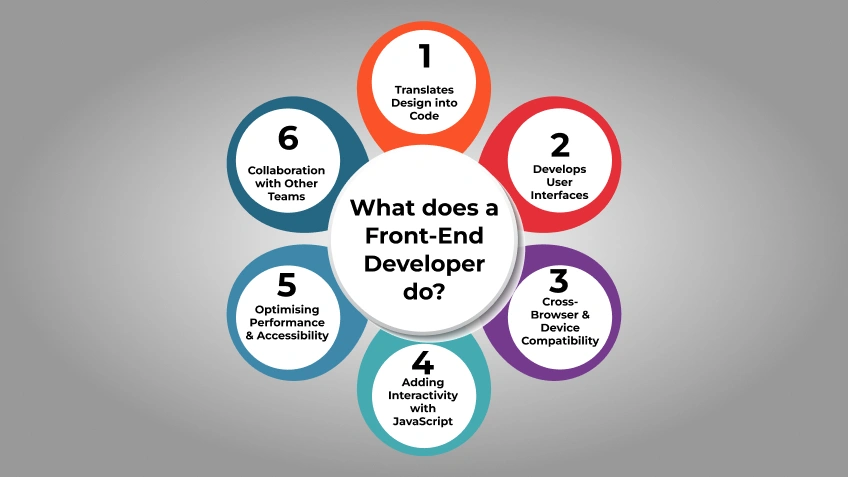
Here is a list of key responsibilities of a front-end developer:
Translates Design into Code
Front-end developers take mockups or wireframes from UI/UX designers and convert them into functional webpages. They use HTML for structure, CSS for styling, and JavaScript for interactivity. Front-end web developers ensure that the visual components align with the design specification across various devices and browsers.
Develops User Interfaces
Creating aesthetically pleasing and intuitive user interfaces is among the core responsibilities of a front-end developer. This task involves selecting appropriate elements, organising content logically, and implementing visual components to guide users effortlessly through the application.
Cross-Browser and Device Compatibility
Front-end developers ensure that applications and websites look perfect and function properly across different devices (smartphones, tablets, & desktops) and various web browsers (Chrome, Safari, Firefox, & Edge). They leverage responsive design techniques and meticulous testing to ensure a consistent user experience across all platforms.
Makes Web Solutions Efficient and Accessible
Front-end web developers use JavaScript and its frameworks, such as React, Angular, Vue JS, etc., to add interactive features and dynamic elements to a website. This includes features like interactive maps, form validation, animations, search filters, and data fetching from back-end APIs to display real-time or personalised content without needing a page reload.
Optimising Performance and Accessibility
Another primary responsibility of front-end developers is to ensure that websites and applications load quickly and run seamlessly across various platforms. They focus on making apps and websites accessible to users with disabilities. It involves making screen reader compatible, smooth keyword navigation, etc., adhering to WCAG (Web Content Accessibility Guidelines) standards.
Collaborates with Back-End Developers and Designers
Front-end developers frequently work with back-end developers and designers to ensure the final product meets functional and aesthetic requirements. They work with back-end developers to implement the server-side logic, APIs, and databases in the front-end. They collaborate closely with UI/UX designers to integrate design iterations, provide feedback on feasibility, and more.
What is the Salary of a Front End Developer?
The salary of a front-end developer varies significantly based on experience, location, skills, expertise, and company size. The table below illustrates the annual salary range of different levels in front-end development roles.
Level of Expertise
Salary Range (Annually)
Beginner Front End Developer
₹3,00,000 to ₹5,00,000
Junior Front End Developer
₹2,30,000 to ₹6,00,000
Senior Front End Developer
₹15,00,000 to ₹25,00,000
Skills Required to Become a Front-end Developer
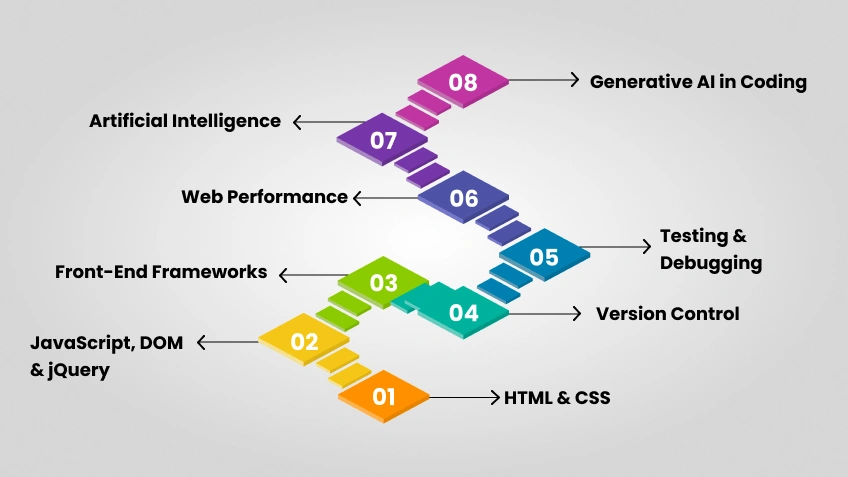
HTML & CSS- The Basics Matter
It is impossible to even imagine a career in front-end development without being fully proficient with its building blocks- HTML & CSS. HTML (HyperText Markup Language) takes care of the structure of the web page, while CSS (Cascading Style Sheets) is used to style and design it.
With the help of HTML, you lay the foundation of your web page and using CSS, you can enhance it by adding colours, layouts, fonts, etc. You will not find any job listing for front-end development that does not require HTML & CSS.
JavaScript, DOM & jQuery
Okay, so you have learnt HTML and CSS to create a website, but what’s next? The next step is learning the world’s most popular programming language, JavaScript (JS). It is JavaScript that allows us to make a website interactive and add loads of functions to it, such as scrolling, animations, audio/video, updating maps in real time and so on. Combine JS with DOM (Document Object Model) and you can manage your website much more efficiently.
jQuery is a popular JavaScript library consisting of innumerable modules, extensions and plugins. Instead of coding everything from scratch, jQuery lets you do these common tasks using just a single line of code. You can use it for things like automatically resizing and adjusting grid layouts, introducing a countdown timer to your website, and much more. Who doesn’t like saving time?
While jQuery is useful, many new JavaScript frameworks are taking over when it comes to building complex and scalable web applications. Here is a list of a few popular frameworks that are replacing jQuery:
React JS: This framework is used for building dynamic and complex user interfaces. Using a virtual DOM and component-based architecture, it builds more efficient and scalable SPAs (Single Page Applications).
Vue JS: This framework is lightweight and progressive, which is used for building interactive UIs. It replaces jQuery by providing a reactive data binding system and component structure for cleaner code and better state management.
Angular: This framework is a full-featured front-end framework used for building enterprise-level applications. Unlike jQuery, it provides two-way data binding, dependency injection, and CLI (Command Line Interface) tools.
Popular Front-End Frameworks
Front-end frameworks are libraries of prewritten code. In layman’s terms, instead of starting from an empty text file, you get a head start if you use these so-called frameworks. They increase efficiency, save time and make the development work simpler. Some of the popular JavaScript frameworks are Angular JS, React JS and Vue.js. Each has its strengths and weaknesses, so pick the frameworks as per your project needs.
Talking about CSS specifically, Bootstrap is its most famous framework. To get the best results, developers often pair frameworks with one another, such as Bootstrap with Angular JS.
Version Control Will Be Your Life Saviour
When you’re coding from scratch and something goes wrong midway, the last thing you want to do is begin from square one. This is where version control systems come into play, with Git being the most widely used.
You don’t have to manually fix all your errors, instead, you can just go back to the previous version of the source code and try a different method. You can easily track and control changes to your code. Trust me, it’s going to save you a lot of time and trouble.
Testing & Debugging
Bugs are a part and parcel of web development. Even the best of minds face this issue on a regular basis. Therefore, it is vital for you to understand how testing and debugging work. First, you run multiple tests on your code, such as UI testing, unit testing and functional testing.
Each test serves its own purpose. Debugging comes after this, where you need to rack your brains and fix the errors by analysing the results of your test. Fortunately, there are programs such as Jasmine and Mocha which will speed up and simplify the process for you by writing and running tests.
Ensuring Smooth Web Performance
Even if you have made the most attractive website out there, it will be of no use if it doesn’t perform well. Users these days demand smooth performance, and if there is a loading delay of even a few seconds and a slight performance glitch, they tend to abandon the website.
After all the hard work you have put in, you don’t want that to happen, right? In order to ensure high performance, you need to compress images and minify CSS and JS, that is, remove unnecessary, extra characters in your code. Thankfully, automation tools like Grunt and Gulp will help you there.
AI in Front-end Web Development
AI (artificial intelligence) is influencing every sector, and front-end development is no exception. AI in front-end development encompasses a range of applications, including AI-powered design tools for converting wireframes to code, automated testing tools for detecting UI/UX issues, intelligent code completion assistance, and AI algorithms that personalise content delivery directly on the client side.
As a front-end developer, you need to understand the methods of integrating and leveraging AI-driven solutions to create more sophisticated user experiences and improve productivity. Learning AI in front-end web development can help you reduce mistakes, quicken your workflow, and aid in integrating more advanced features for users.
Generative AI in Coding
Gen AI or Generative AI tools like ChatGPT and Github Copilot can be smart coding partners for front-end developers. These AI tools assist developers in completing functions, suggesting code snippets, or even generating whole code blocks based on prompts. Automating such tasks means faster prototyping, assistance in writing complex JavaScript functions or CSS styles, and minimised boilerplate code.
Using Generative AI, front-end developers can quickly create common code, try novel ideas quickly, create forms, and save time on repetitive tasks. Although this technology will not replace the front-end developers, using Generative AI in coding and having proficiency in leveraging and refining AI-generated code is a critical skill to boost accuracy and efficiency.
For example, if you need a form, you can give GenAI the following prompt:
“Create a responsive HTML form using semantic HTML5 and modern CSS (Flexbox or Grid). The form should include the following fields: Full Name, Email, Phone Number, Message (textarea), and a Submit button. Style the form with CSS to make it mobile-friendly, with clear spacing, labels above inputs, rounded borders, and a clean, minimal look. Add media queries to optimise the layout for both desktop and mobile. Include hover and focus states for inputs and the submit button.”
Concluding Thoughts
Apart from these technical skills, if you have knowledge of basic UI/UX designing and wireframing, that would go a long way.
Also, don’t forget about the soft skills one must possess to become a front-end developer. These include good communication skills, teamwork, creativity and a knack for problem solving.
Since web development is evolving with each passing day, small things such as reading blogs, articles, and following professional developers on social media will help you in your endeavour. You can enrol in our full-stack web development to learn front-end as well as back-end web development.
Remember, the learning must never stop!
FAQs
Is front-end developer a good career?
Absolutely! Front-end development is a good career as this skill is highly sought after in the tech industry. This field offers competitive salaries and rapid growth opportunities across various industries.
What are the first skills to learn as a new front-end developer?
Start with the foundational skills, i.e. HTML for content structuring, CSS for styling, and basic JavaScript for adding interactivity.
How long does it take to become a front-end developer?
The time to become a front-end developer greatly depends on your knowledge, grasping ability, and dedication. However, depending on your learning pace and dedication, you can become a front-end developer in 3 to 6 months.
Is it hard to become a front-end developer?
No, the initial learning curve for HTML and CSS is gentle, but you need consistent learning and practice to master front-end development. Also, JavaScript and frameworks need more focus.
What are the essential skills required to become a front-end developer?
Other than HTML, CSS, and JavaScript, you need to possess essential skills like DOM manipulation, responsive design, and knowledge of at least one JavaScript library/framework like React or Angular, and basic version control (Git).
How important are design skills for a front-end developer?
Having design skills is not a primary requirement for frontend developers, but knowledge of basic design principles and aesthetics can be advantageous.
Can a front-end developer earn more than a back-end developer?
Yes, frontend developers tend to earn more than backend developers due to their expertise in complex server-side logic, database management, and system architecture.
How important is JavaScript and the DOM in front-end development?
JavaScript and DOM are absolutely important in modern front-end development. While JavaScript allows interactivity, the DOM helps in manipulating web page content.
Is Bootstrap necessary to learn in front-end web development?
No, learning Bootstrap is not necessary in front-end web development. However, it can be a helpful CSS framework for consistent styling and quick prototyping
Is learning Git important in front-end web development?
Yes, learning Git is very important in front-end web development. Git is essential for version control, managing code, and collaboration in projects.
What are the trending career paths after learning front-end development?
After mastering front-end development, you can explore several in-demand tech roles such as front-end developer, full stack developer, UI/UX engineer, mobile app developer (React Native/Flutter), front-end architect/lead front-end developer, and other specialised framework developer roles.
 info@karmickinstitute.com
 +919836423755
  +919836423755

 Login
Login