info@karmickinstitute.com
 +919836423755
  +919836423755
Get up to 25% OFF on all IT courses Enrol Now Only 20 Slots Remaining! Limited Time Offer!
By Tanmay Das

The data science world you knew existed a few years back is now ‘OBSOLETE’!
With the rapid growth of Generative AI, advanced cloud computing, novel ethical regulations, and more, having simple knowledge of Python and basic machine learning will not help you secure your career in 2026. Now, the industry is demanding professionals with advanced data science skills. Keeping that in mind, we have outlined 10 essential skills that lead to a future-proof data science career.
Today, the world is not just generating data; it is running on it.
As 2026 is just a few months away, the data science domain is undergoing a radical transformation, driven by the rapid growth of advanced cloud computing, Generative AI, and more.
Gone are the days when mastering just one programming language or having knowledge of basic modelling was enough to get a job.
Today, successful data scientists are not the ones who can just analyse data sets; they translate complex, raw data into a strategic business direction.
Now, industry demands a new breed of professionals with expertise in cloud-native big data architectures and the ability to transform complex models into actionable business strategies.
If you are looking for a future-proof, high-value, and top-salaried role in the billion-dollar data domain, you need to acquire in-demand data science skills focused on cutting-edge innovation.
This comprehensive guide breaks down the top 10 skills needed for data scientists. Mastering these crucial data science skills by 2026 will help you grow, remain indispensable, leading to exponential growth and a high paycheque.
Let’s dive in!
Data science is the systematic and scientific approach of leveraging algorithms, methods, processes, and systems to pull out insights and information from various data forms, including structured and unstructured data.
The core objective of data science is to enable data-driven decision-making and predictive modelling to solve complex problems across numerous industries.
The following are the Core Pillars of Data Science:

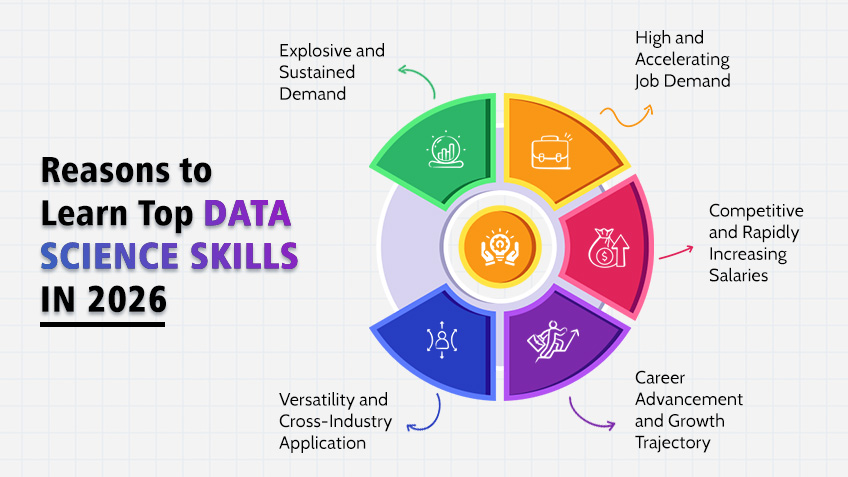
Driven by ongoing, massive digital transformation across numerous industries, mastering top data science skills is undoubtedly a strategic career move. Here are the five compelling pointers that highlight why investing in this sought-after skill is crucial for a future-proof and advancing data science career.
India’s data analytics market is experiencing explosive growth, projected to surge from $3.55 billion in 2024 to a massive $21.29 billion by 2030. The surge in the data science market is creating an unprecedented need for professionals who can transform raw data into actionable insights.
This high volume, sustained demand translates into numerous job opportunities and significant job security for aspiring data scientists.
Organisations across all industries are rapidly adopting big data strategies and AI. This surging demand has created the urgent need for machine learning engineers and data scientists.
The BLS (Bureau of Labour Statistics) reports that machine learning job demand is expected to grow by 23% over the decade spanning 2022 to 2032. Additionally, the demand for data scientists is projected to grow 34% from 2024 to 2034, a rate that is much faster than the average job growth.
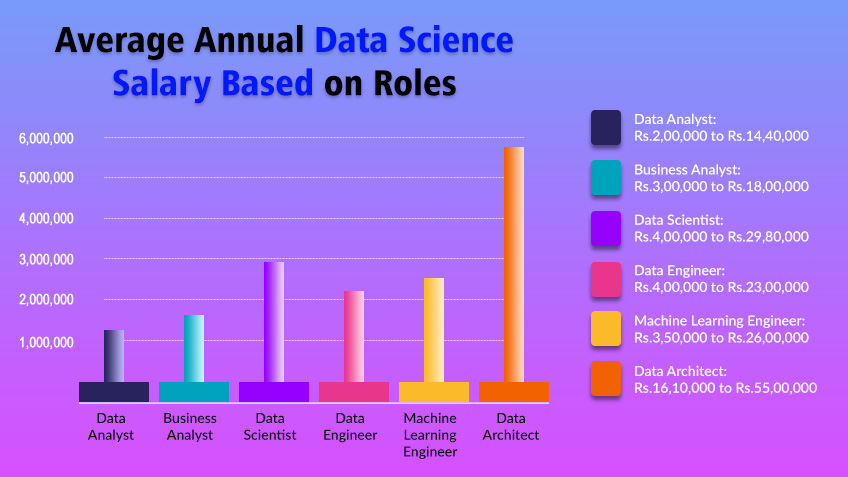
Due to a significant data science skills gap, companies are struggling to find qualified professionals. This scarcity of top-tier talent makes it the highest-paid profession, with salaries ranging from ₹5,00,000 to ₹36,00,000 per year.
Companies across all industries are paying competitive salaries to expert data scientists who can extract valuable insights from raw data sets.
A data science career path leads to many in-demand, high-value roles. Your career can quickly transition you from a junior analyst to a senior data scientist and eventually to high management positions like CDO (chief data officer) or data architect.
However, to succeed and achieve rapid career progression in the data science field in India, you need to continuously learn, get industry-aligned data science training, and stay updated.
Data science application is not limited to technology; it is the backbone of various industries, including healthcare, finance, e-commerce, government, and more.
Once you master in-demand data science skills, you make yourself a valuable asset for any company, which increases your earning potential and leads you to more leadership opportunities.
2026 is expected to be a year where data science and AI will significantly transform numerous industries. To thrive and keep your skills relevant, you need to move beyond basic concepts and acquire skills that will not only secure your job but also propel your career forward.
The following are the top 10 skills required for data scientist. Acquiring them will make you indispensable and accelerate your career progression.

Having proficiency in programming languages like Python and R is crucial as they are the primary languages for statistical and algorithm development. Focusing on Python for data science and R can provide a strong foundation.
This also includes expertise in SQL for efficient data collection and database querying. Learning Python for data analysis, R, or SQL is an essential foundational technical skill for working with large, structured data. Python, R, and SQL are among the top data science programming languages.

Having an in-depth knowledge of the specific industry or business is crucial, e.g. healthcare, finance, e-commerce, etc. Domain knowledge, also known as business acumen or business understanding, enables the data scientists to understand industry, problem, and organisational goals for which the in-depth analysis will be done.
This knowledge helps you in asking the right questions, selecting relevant data, and ensuring the solution is aligned with the strategic business goals.

Also called EDA or data wrangling, this skill involves cleaning, transforming, and structuring raw data sets into a usable format. This process can be done using the Python library Pandas.
As a data scientist, you need to be proficient in exploratory data analysis to extract patterns, irregularities, and relationships within raw datasets before beginning the modelling process.

Machine learning and artificial intelligence are the core skills required for building predictive models and AI systems. This requires expertise in classical methods like Regression and advanced techniques like Deep Learning using tools like TensorFlow and PyTorch to teach computers to learn patterns and make smart, strategic decisions.

Statistical and mathematical skills form the theoretical backbone of data science. Statistical skills involve a deep understanding of concepts like probability, statistical testing, distributions, hypothesis testing, and regression analysis for correct data interpretation and model validation.
Mathematical skills include proficiency in linear algebra and calculus to understand how many deep learning and machine learning algorithms fundamentally work.
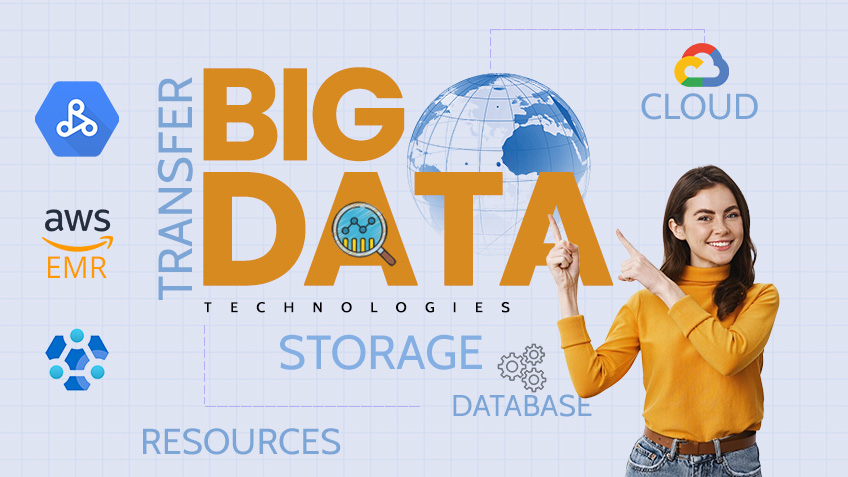
Big data technologies are essential for handling and processing massive, real-time datasets that cannot be managed by a single machine. For this, you require proficiency in frameworks like Hadoop and Apache Spark. Additionally, familiarity with cloud-based big data services like AWS EMR, Google Cloud Dataproc, and Azure HDInsight is highly valued in the market.

Data scientists who have a strong grasp of data engineering or working knowledge of the data pipeline are significantly more effective. Data engineering is a skill that focuses on building and maintaining the data pipeline, which is a system that gathers, transforms, and stores data.
This skill gives data scientists the ability to handle and optimise data flow from its source to its analysis. For this, proficiency in workflow managers like Apache Airflow is essential to automate and scale the whole data preparation process.

Data visualisation is a key skill of translating complex, raw data sets into clear, compelling, and easy-to-understand visuals like graphs, charts, dashboards, etc. For this, expertise in tools like Power BI, Tableau, Seaborn, or Matplotlib is essential to effectively communicate extracted insights to both technical and non-technical stakeholders.

NLP, or natural language processing skill, is the ability to work with text and speech data to derive insights. This skill is vital for building applications that understand and process human language, such as chatbots and sentiment analysers. Additionally, familiarity with libraries like NLTK, spaCy, and transformer-based models (like BERT or GPT) can give you a major advantage.

Soft skills are as important as technical proficiency in data science and are also among the top 10 IT skills in demand that significantly boost your resume. Soft skills include communication and storytelling skills to clearly explain complex concepts and findings to both technical as well as non-technical audiences via data visualisation.
Problem-solving and critical thinking are also part of soft skills, which help you analyse a problem and come up with a logical solution. Soft skill also includes collaboration, which is working effectively with cross-functional teams.
Data science is a rapidly expanding and transforming field due to Generative AI and advanced cloud computing, and more cutting-edge, evolving technologies, making basic Python and simple modelling obsolete for a future-proof career.
To secure a high-value, top-salaried role, you must master a comprehensive skill set focusing on three key areas:
To be successful, you need to move beyond basic analysis and acquire the top data science skills that we discussed in our blog.
If you are interested in a data science career and don’t know where to begin, you can book a free career counselling session with us to resolve all your doubts in one go.
We offer the best data science certification course with Gen AI & ML that propels your career forward in just 6 months.
Call us/WhatsApp at 9836423755 | 6289562294 | 8910945693 and book a free demo class to get first-hand experience!
What are the top skills required for Data Science?
The top skills required for data scientists are programming languages (Python/R and SQL), a strong knowledge of statistics and mathematics, and expertise in machine learning and data visualisation.
Will data science be in demand in 2026?
Absolutely! The demand for data science professionals is projected to grow rapidly in 2026 and beyond due to an increasing amount of data and increasing dependency on AI.
What skills are required to master data science?
The skills required to master data science are proficiency in machine learning algorithms, big data technologies, deep learning, and essential soft skills.
Will data science replace AI?
No, data science will not be replaced by AI, as both are interconnected fields. Data science leverages scientific methods to extract meaningful insights from data, while AI uses algorithms and data to build intelligent systems.
Which is better, AI or data science?
None is inherently better, as both AI and data science serve different purposes. Data science is more focused on data extraction and analysis, while AI emphasises creating systems mimicking human intelligence.
How long does it take to acquire data science skills?
Acquiring foundational knowledge of data science can take 3 to 9 months. Continuous learning, practical experience, and an industry-recognised data science certificate are crucial to attain advanced proficiency in this field.
What career opportunities can I expect after learning Data Science?
There are ample career opportunities after attaining data science mastery. You can pursue sought-after roles like data scientist, data analyst, data engineer, machine learning engineer, or BI (business intelligence) analyst in various industries, including finance, e-commerce, healthcare, and more.
Why choose the Karmick Institute for Data Science training?
For data science mastery, you require structured data science training and practical experience with industry-recognised certification to stand out. Karmick Institute offers a comprehensive curriculum, hands-on projects, 100% placement assistance, industry expert training, and prestigious certification from E&ICT Academy- IIT Guwahati. All these offerings help you gain essential data science skills, stand out, and secure your dream job in the field.
Read more blogs:


 Login
Login