info@karmickinstitute.com
 +919836423755
  +919836423755
Get up to 25% OFF on all IT courses Enrol Now Only 20 Slots Remaining! Limited Time Offer!
By Tanmay Das
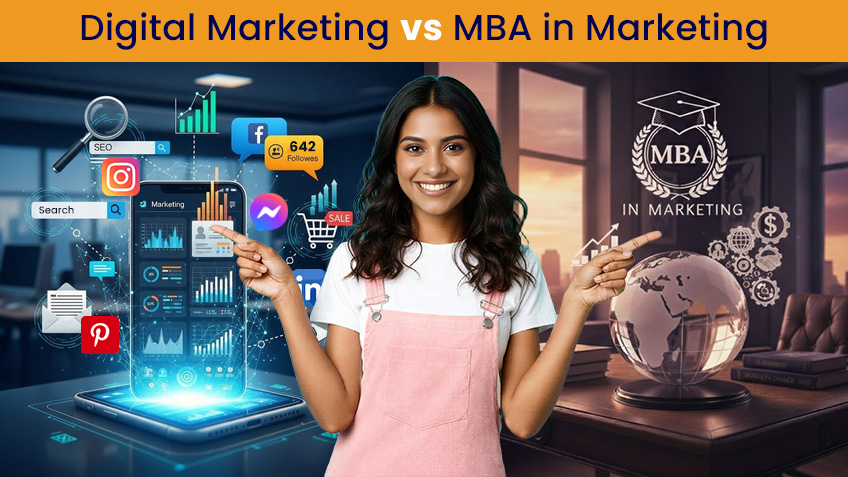
Will your 2-year MBA marketing degree hold its value against a skill-focused digital marketing course in an era highly driven by Generative AI, multi-channel customer journeys, and viral reels? This question keeps every aspiring professional, even working people, up at night. To help you in your decision-making process, this blog provides a straightforward analysis of Digital Marketing vs MBA, revealing the strongest career return on your investment.
The do’s and don’ts of marketing have drastically changed in recent years, and artificial intelligence’s strategic adoption has become a non-negotiable skill. While a traditional MBA (Master’s in Business Administration) builds a broad, theoretical foundation for management, a digital marketing course equips you with job-ready skills quickly that employers seek right now!
However, according to the Times of India, MBA graduates in India demonstrate the highest employability rate at 72.76%, followed by those holding a B.Tech degree (70.15%) and Science (62.81%). This highlights MBA program still holds significant weight in the corporate world.
Now, the real question is, which one is better?
While one path (digital marketing) immediately equips you with job-ready skills, the other (MBA) remains strong for generalist management roles.
Let’s not leave any room for any confusion. This Digital Marketing vs MBA blog helps you determine which path offers the fastest, most relevant, and adaptable skill set for 2026 and beyond.
To truly understand which career path is right for you, let’s explore what exactly these two domains are.

MBA stands for Master of Business Administration. An MBA in marketing is a two-year post-graduate degree that emphasises building strategic business leaders who are adept at managing marketing functions.
This includes branding, customer behaviour, market research, pricing, and distribution across both traditional and digital channels.
An MBA degree provides a comprehensive foundation in finance, operations, HR (human resources) and strategy with specialisation in the marketing domain. This degree prepares graduates for senior management positions and directorial roles.

Digital marketing is a sort of advertising that leverages the internet and devices, including mobile, computers, and other digital platforms, to promote a brand’s products and services. Digital marketing is done primarily through online channels like SMM (Social Media Marketing), SEO (Search Engine Optimisation), SEM (Search Engine Marketing), PPC (Pay-Per-Click) advertising, and content marketing.
A digital marketing degree equips you with specialised, technical skills that help you drive traffic to a website, generate leads, and optimise conversion rates through measurable, data-driven marketing campaigns.
Digital marketing is one of the top 10 IT skills in demand. If you are looking for a concise introduction, you can start with the fundamentals of digital marketing through a digital marketing short course.
| Feature | Digital Marketing Course (Short Course/Advanced Certification) | MBA in Marketing (2-Year Post-Graduation Degree) |
| Core Focus | Execution, Tools, & Metrics. | Strategy, Leadership, & Management. |
| Curriculum Scope | Focuses purely on SEO, PPC, Social Media, Content, and Analytics tools. | Focuses purely on finance, operations, HR, consumer behaviour, and some digital theory. |
| Duration & Cost |
|
|
| Skills Gained |
|
|
| Career Paths |
|
|
| Value in the Industry |
|
|
Choosing between an MBA and digital marketing can be confusing, as both fields offer strong career prospects with impressive salaries. You can acquire this expertise through the best digital marketing certification.
This digital marketing vs MBA section mainly focuses on the career scope each field leads to. Let’s understand each field in detail.
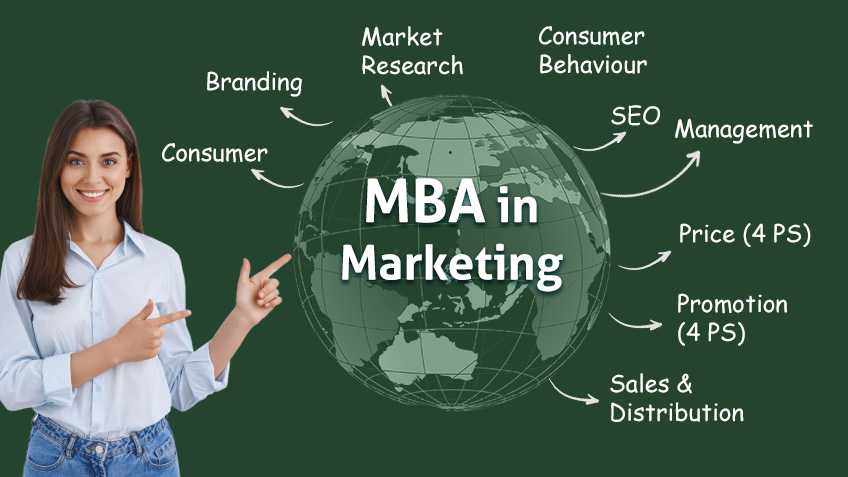
Considered a versatile and traditional path, the MBA in marketing offers a holistic foundation in the principles of marketing and business management. This field prepares you to oversee the entire marketing function.
Fundamental Concepts: Consumer behaviour, branding, market research, sales and distribution, and the core 4 Ps (Product, Price, Place, Promotion).
| Job Role | Key Responsibilities |
| Brand Manager | Develops and executes overall brand strategy, positioning, and campaigns. |
| Product Manager | Oversees the whole product lifecycle, from conception and development to launch and market performance. |
| Marketing Manager | Manages the entire marketing department or a specific product line, coordinating all marketing efforts (traditional and digital). |
| Market Research Analyst | Conducts deep market research and analyses consumer data to inform strategic business decisions. |
| Sales Director/Manager | Leads the sales team, sets targets, and aligns sales strategies with marketing goals. |
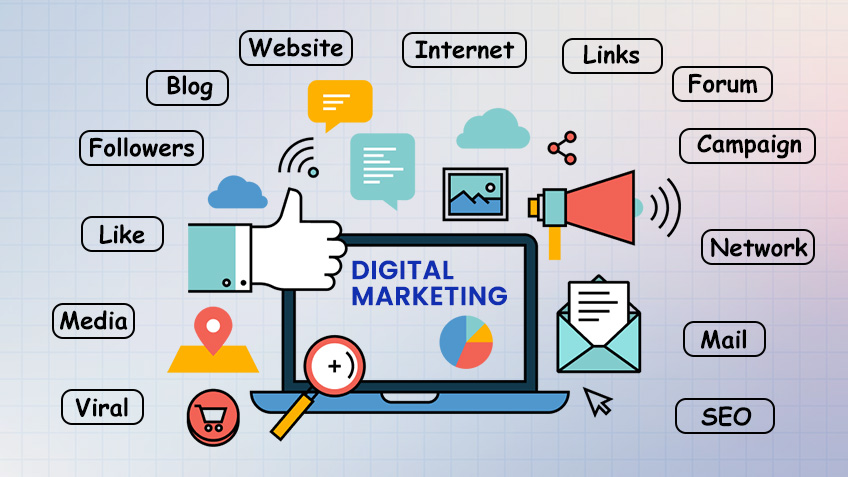
A specialised and skills-based field, digital marketing focuses exclusively on promoting products and services using digital channels and technologies, which can be acquired through the best digital marketing certification. Being one of the top short-term job-oriented courses, the digital marketing course market in India is expected to reach $3073.24 Million by 2032.
Fundamental Concepts: SEO, SEM, social media marketing, content marketing, email marketing, analytics, and PPC advertising.
| Job Role | Key Responsibilities |
| SEO/SEM Specialist | Optimises website visibility in search engines (organic and paid) to drive targeted traffic. |
| Social Media Strategist/Manager | Manages a brand’s presence on social platforms, creating content and driving engagement and community. |
| Performance Marketing Lead | Focuses on data-driven, measurable campaigns (like PPC and affiliate marketing) to maximise return on investment (ROI). |
| Digital Marketing Manager | Develops, implements, and manages online marketing strategies and campaigns across all digital channels. |
| Content Marketing Manager | Oversees the creation and distribution of valuable content (blogs, videos, guides) to gain and retain customers. |
The comparison table below offers a more comprehensive view of job roles and associated salary brackets for both the MBA in marketing and digital marketing fields.
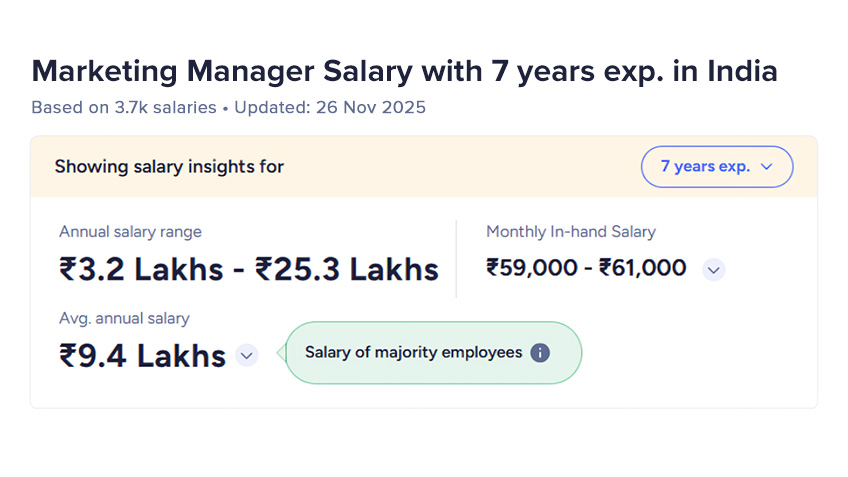
Source: Ambition Box
The below table shows the annual salary range for senior marketing and strategic roles in India.
| Role | Annual Salary Range |
| Market Research Analyst | ₹2,00,000 to ₹9,00,000 |
| Brand Manager | ₹12,00,000 to ₹25,00,000 |
| Product Manager | ₹7,00,000 to ₹40,00,000 |
| Marketing Director / VP | ₹21,00,000 to ₹90,00,000 |
| Chief Marketing Officer (CMO) | ₹28,00,000 to ₹1,00,00,000 |
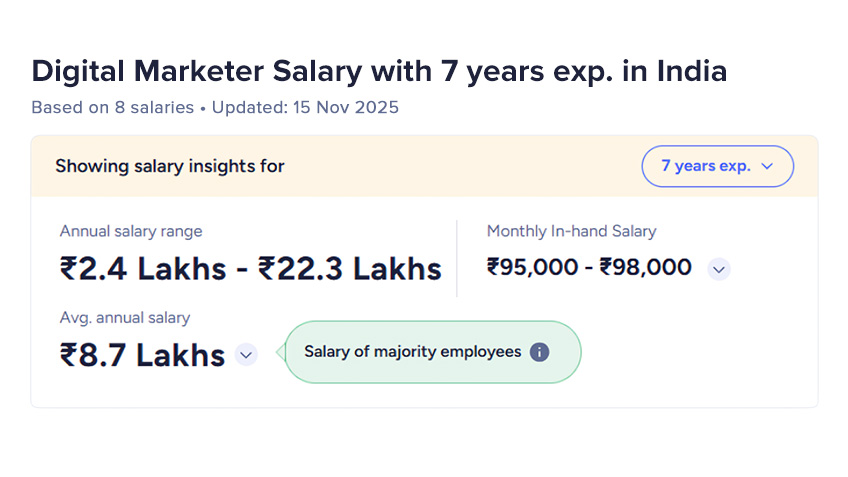
Source: Ambition Box
The below table outlines the annual salary ranges for key Digital Marketing roles in India.
| Role | Annual Salary Range |
| SEO/SEM Specialist | ₹2,00,000 to ₹13,00,000 |
| Social Media Strategist/Manager | ₹2,00,000 to ₹10,00,000 |
| Performance Marketing Lead | ₹4,20,000 to ₹50,00,000 |
| Digital Marketing Manager | ₹3,00,000 to ₹20,00,000 |
| Content Marketing Manager | ₹5,00,000 to ₹24,00,000 |
| Head of SEO | ₹4,20,000 to ₹40,00,000 |
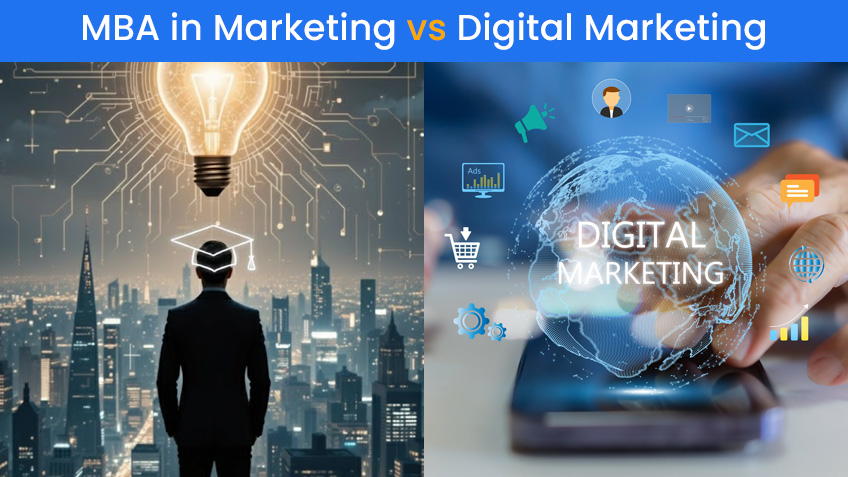
While an MBA in marketing trains learners to be chief marketing officer or chief executive officer of the brand who set the strategy and delegate the execution, digital marketers are specialists and professionals with technical expertise who measure, execute, and optimise various tactics to attain immediate results online.
| Specific Skills Required | Primary Focus |
|
Developing the long-term vision, value proposition, and competitive positioning of a brand/product. |
|
Leading large teams, managing multi-channel campaigns, and coordinating with departments like Finance, Sales, and Product Development. |
|
Understanding ROI, budgeting, pricing strategies, and how marketing decisions impact the company’s bottom line and supply chain. |
|
Conducting deep, theory-backed research to understand why people buy, not just what they click. |
|
Overseeing the consistent messaging across all platforms, including TV, print, and physical distribution points. |
| Specific Skills Required | Primary Focus |
|
Measuring traffic, user behaviour, and campaign effectiveness with precision; using data to optimise online funnels. |
|
Driving targeted traffic and leads from search engines and social platforms, managing budgets, and optimising for ROI. |
|
Creating, distributing, and optimising high-quality, engaging content that attracts and converts an online audience. |
|
Proficiency in the software and platforms required to build, track, and automate digital campaigns. |
|
Quickly adjusting to platform algorithm changes and new technologies (e.g., AI/Chatbots). |
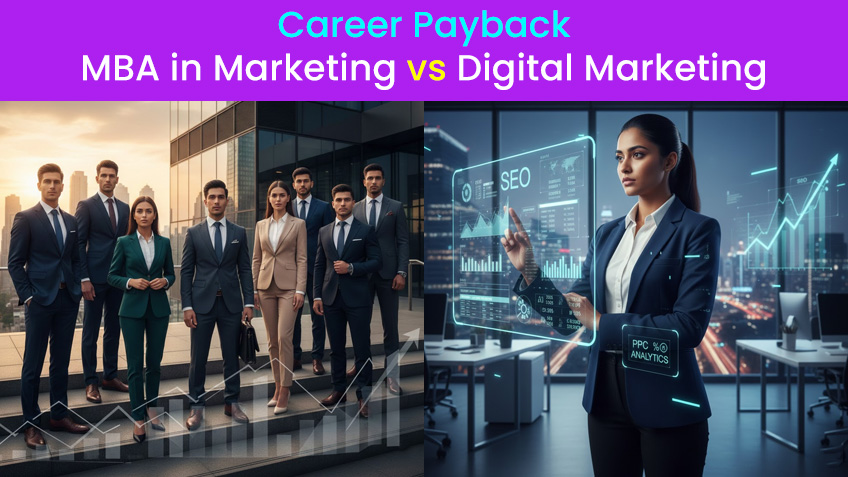
Choosing between an MBA in marketing and digital marketing is a critical career decision. As both fields offer distinct career payback, this digital marketing vs MBA will guide you in your path. The following section highlights the potential career payback associated with each field.
An MBA is a long-term investment and is specifically designed to give you comprehensive business knowledge, lead to big roles and offer career stability. The career payback is comparatively slower initially, but it leads to the top roles in big corporations.
Advantages & Payback:
The digital marketing skills comparatively offer faster ROI, as the cost of digital marketing certificate programs is low, quickly completed, and leads to immediate employment. However, career payback is more performance-driven.
Advantages & Payback:
In this digital marketing vs MBA guide, you explored all the critical details from career scope, job roles, salaries, cost, and skills required to pay back that each field offers.
The correct answer to which field is more ‘relevant and future-proof’ in 2026 depends on your personal ambition.
While an MBA in marketing provides comprehensive business knowledge and prepares you for big roles, a top-rated digital marketing course offers the fastest route to employment with rapid salary acceleration.
If you are still confused about your choice, we can help you clear all your doubts and give you a launchpad to a high-growth career.
Book a free career counselling session today: 9836423755 | 6289562294 | 8910945693.
Which is better, an MBA in marketing or digital marketing?
While an MBA in marketing offers a strategic, broader foundation, digital marketing provides in-depth, specialised knowledge of online channels such as social media, SEO, and analytics. The better choice between these two depends on your career goals and preferences. If your aim is quick, hands-on expertise, a digital marketing short course is more efficient.
Is AI replacing digital marketing?
No, AI is not replacing digital marketing professionals; rather, this cutting-edge tool is transforming the field by automating repetitive tasks like data analysis and campaign optimisation. Understanding the fundamentals of digital marketing is key to leveraging AI effectively.
Which pays more: an MBA in marketing or an MBA in digital marketing?
Both specialisations can lead you to high-paying roles. It depends on your experience, specific role, location, and company. However, specialised roles gained through an advanced digital marketing course often see rapid salary growth.
What kinds of jobs can you get after getting an MBA in marketing?
After completing an MBA in marketing, you can get high-level positions such as product manager, marketing manager, or brand manager.
Is digital marketing and marketing management the same?
No, digital marketing and marketing management aren’t the same thing. Marketing management is a comparatively broader discipline than digital marketing. While marketing management oversees all marketing activities (traditional, digital, and strategy), digital marketing specifically focuses on leveraging online channels (social media, SEO, and email) to attain campaign goals.
Which has more scope, marketing or digital marketing?
Looking at the current market, digital marketing is expected to grow faster and have a more dynamic scope than a simple marketing degree. As the online platforms are constantly shifting and evolving with the advent of artificial intelligence, digital marketing has a wider scope across various industries. Pursuing a digital marketing certificate is highly recommended for professionals looking to start immediate employment and stay relevant.
Is an MBA more difficult than digital marketing?
As an MBA covers broader concepts including marketing, finance, operations and leadership, this field is considered more rigorous. A digital marketing course is shorter and focuses more on practical, specialised, and technical skills. Many programs also offer a flexible learning schedule through digital marketing online classes.
What kinds of jobs can you get after completing a digital marketing course?
After completing a digital marketing course, you can get specialised roles such as SEO Specialist, Social Media Manager, Content Marketing Manager, PPC/Performance Marketing Specialist, or Email Marketing Specialist. Digital marketing is a must learn skill as it requires technical expertise and focuses more on execution.


 Login
Login