info@karmickinstitute.com
 +919836423755
  +919836423755
Get up to 25% OFF on all IT courses Enrol Now Only 20 Slots Remaining! Limited Time Offer!
By Tanmay Das
Think about it: in this rapid-paced world, would you still visit a website if it takes more than 3 seconds to load? Your answer is likely an absolute ‘NO’. In fact, we have reached a point where a 1-second delay costs businesses nearly a 7% drop in conversion rate.
Why?
Users like you and me all want things instantly now. That’s why for businesses catering to us, high performance is no longer optional; instead, it’s the core of the future of web development.
According to Business Research Insights, the global web development market is projected to hit a staggering $82.4 billion by 2026. Additionally, 53% of mobile users abandon the websites that take longer than 3 seconds to load. Therefore, high performance and quick load are not just nice-to-have features, but rather a must-have one.
You must be thinking, why do these numbers matter for your career?
So, here are the key points you need to know.
First and foremost, tech giants are desperately hiring developers who have expertise in performance optimisation. Plus, 90% of engineering teams now leverage AI in web development.
So, the future of web development belongs to those who can use cutting-edge technologies like AI to build faster and smarter applications.
But wait, there are a few more hidden shifts in web development that you need to know about.
Let’s explore the game-changing trends and tools that are transforming the future of web development and creating new opportunities for developers everywhere.
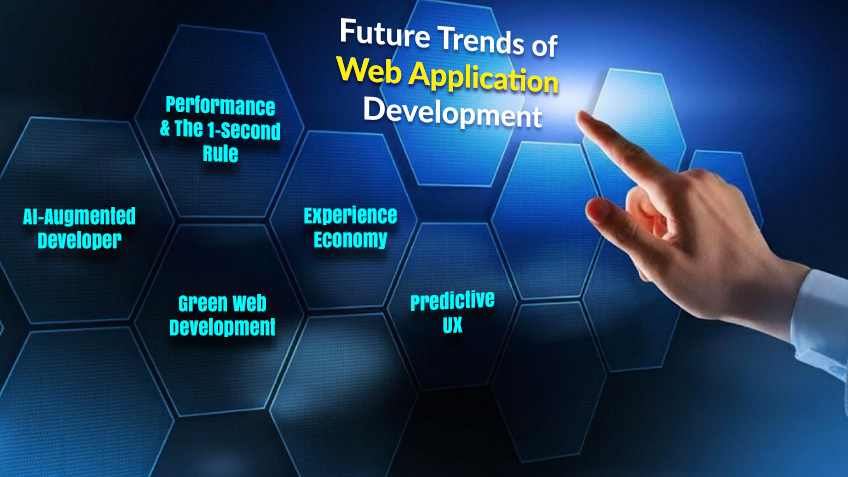
In 2026, web applications will be smarter and provide more immersive experiences that learn from their users. To stay ahead, developers must know beyond simple code and embrace AI integration and lightning-fast performance. Below are the key trends you need to master to thrive in the future of web development.
Moving forward, the future of web development is expected to be more architectural. This means developers will no longer need to write every line of code from scratch. Instead, they will use natural language to describe results, while AI agents like Cursor or Windsurf would handle complex tasks like generating tests, boilerplate, and documentation.
Moreover, AI in web development has evolved from a simple spell-checker into a comprehensive digital partner. It understands the entire project, identifies security risks instantly, and helps users structure their app perfectly, allowing them to prevent bugs before they even occur.
As already mentioned, speed can cost 7% conversion loss to businesses; as a result, speed has become a survival requirement for all. If a page takes more than 1 second to load and become interactive, it is considered broken. Tools like Qwik and Astro keep websites fast by sending only the essential code to the browser, rather than loading the entire application all at once.
Instead of fetching data from a central server, applications now run logic at the “Edge” (closest to the user’s physical location). By doing so, it ensures instant response times from any part of the world.
In the Experience Economy, it’s not just about what you buy; it’s about how the interaction makes you feel. Success is measured by the positive, memorable journey a user has while using an app. Web apps are now using small animations, storytelling, and engaging design to create a stronger connection with users.
Whether you are making a career in full stack web development or specialising in one area, the landscape has shifted toward AI-driven efficiency and user-centric “Experience Economies.
Instead of reacting to what a user does, web apps now predict what they will do next. This future web development trend moves from “Responsive” design to “Adaptive” design. Predictive UX utilises machine learning and AI in web development to analyse historical data and real-time behaviour to forecast user needs before they state it.
Using local AI models, a website might change its navigation menu or highlight specific buttons based on a user’s past behaviour and current mouse movements. If the system predicts a user is looking for “Support,” the contact widget appears automatically before the user even has to search for it.
Finally, green web development focuses on reducing the carbon footprint of digital products through energy-efficient coding and sustainable infrastructure. For example, apps are being built to detect if a device is on “low power mode” or a weak network and automatically serve lightweight, energy-efficient versions of the site.
Many business apps now use dark mode as the default to save battery on OLED screens. This doesn’t just help the environment, it also makes apps run faster, rank better on Google, and become easier for everyone to use.
In 2026, the future of web development has shifted from simple coding to a multidisciplinary domain highly dominated by AI integration, cloud-native architectures, and more technologies.
The table below outlines the primary career pathways, the emerging trends, essential tools required for each, and their projected annual salary in the current market.
| Career Pathway | Essential Skills & Tools | Emerging Trends | Expected Annual Salary |
| Frontend Specialist |
|
Using WebXR for AR/VR experiences and AI-driven personalisation. | ₹8L – ₹18L |
| Backend Architect |
|
Building APIs that connect LLMs to proprietary data via RAG (Retrieval-Augmented Generation). | ₹12L – ₹25L |
| Full Stack Developer |
|
Leveraging AI agents to handle boilerplate, focusing on system design. | ₹10L – ₹22L |
| Cloud-Native Engineer |
|
Moving compute logic closer to the user to eliminate latency. | ₹14L – ₹28L |
| DevSecOps Engineer |
|
“Shifting left” by integrating automated vulnerability scanning during the coding phase. | ₹12L – ₹26L |
| UX/UI Designer |
|
Using AI to rapidly prototype layouts and accessible colour schemes. | ₹6L – ₹15L |
| Platform Engineer |
|
Reducing “cognitive load” for developers by building self-service infrastructure. | ₹15L – ₹30L |
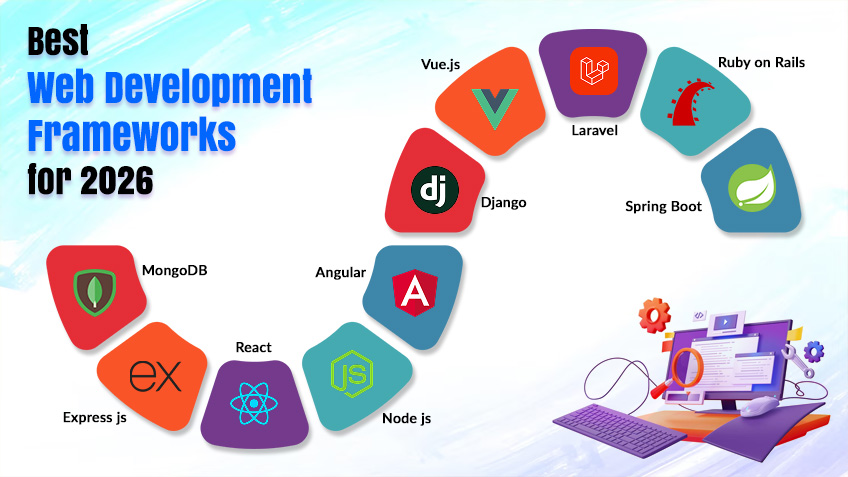
In the web development world, what was considered innovative a few years ago is now partially outdated or has completely vanished. As we move through 2026, the industry has dramatically shifted its focus from component libraries to AI ecosystems, edge-first rendering, and zero-runtime overhead.
Here is the list of top web development frameworks dominating the landscape in 2026.
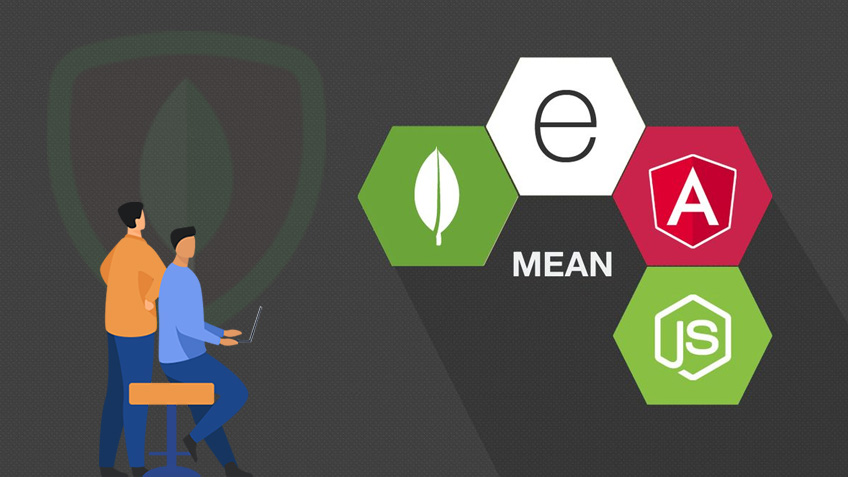
MEAN (MongoDB + Express.js + Angular + Node.js) remains the gold standard for building high-performing enterprise applications. As MEAN stack uses JavaScript for both frontend and backend, it allows for a unified workflow.
Why Does It Matter in 2026?
In 2026, with the rise of JSON-centric AI models, MEAN’s stack flexibility with data makes it developers’ go-to choice for building modern, social-media-style apps and real-time dashboards.
Why Does It Matter in Your Career?
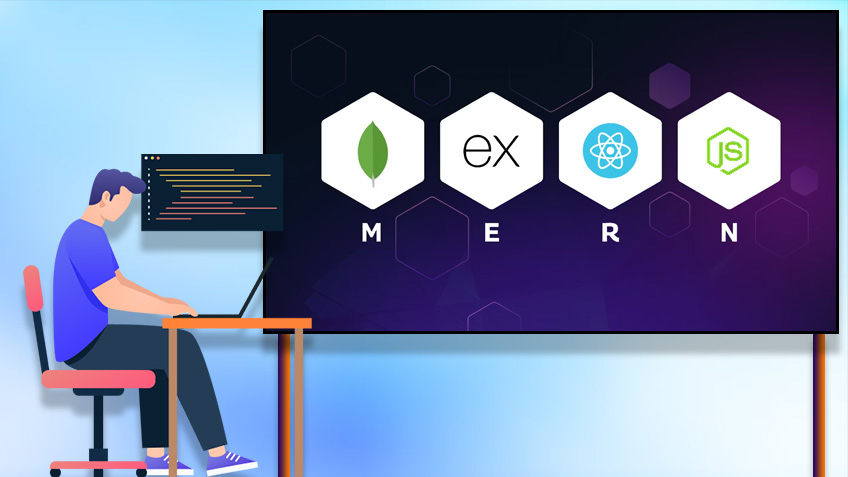
MERN (MongoDB + Express.js + React + Node.js) is the most popular variant of the JavaScript stack, swapping Angular for React to focus on building highly interactive user interfaces.
Why Does It Matter in 2026?
In 2026, the MERN stack is the fastest way to turn an idea into a scalable MVP (Minimum Viable Product).
Why Does It Matter in Your Career?
The Django and React stack combines the “batteries-included” power of Python (Django) for the backend with the sleek user interface of React for the frontend.
Why Does It Matter in 2026?
As AI becomes the core of every app, Python is the non-negotiable language for AI integration. Using Python Django allows you to build secure, AI-ready backends faster than any other framework.
Why Does It Matter in Your Career?
Angular and ASP.NET Core are a great choice for big companies. These stacks combine Microsoft’s powerful ASP.NET Core for the backend with Google’s reliable Angular for the frontend. We can say it’s the
Why Does It Matter in 2026?
Enterprise companies, like banks and insurance trusts Angular + ASP. NET Core stack for their long-term stability and deep integration with Azure Cloud and enterprise AI tools.
Why Does It Matter in Your Career?
Laravel (PHP) and Vue.js offer one of the most developer-friendly experiences in the industry. Laravel + Vue.js stacks are incredibly easy and enjoyable for developers to use, making the building process smooth and stress-free.
Why Does It Matter in 2026?
Laravel is an all-in-one tool that easily handles everything from live chats to AI tasks. It is the top choice for freelancers and even people building their own businesses.
Why Does It Matter in Your Career?
Ruby on Rails is designed to be fun and easy for programmers to use. This framework is a favourite for new companies because it helps them build and launch their apps faster.
Why Does It Matter in 2026?
With version 7+, RoR has removed the need for complex “build tools,” making it incredibly fast to deploy. Ruby on Rails is considered the “specialist’s choice” for high-speed product development.
Why Does It Matter in Your Career?
Spring Boot (Java) and React are built for speed and power. This combo is the top choice for apps that need to handle millions of users simultaneously without crashing.
Why Does It Matter in 2026?
Java powers the internet’s largest systems. In 2026, Spring Boot’s Virtual Threads enable it to handle massive AI traffic with the highest efficiency.
Why Does It Matter in Your Career?

Choosing the right stack is more like picking the ideal career trajectory. The following section highlights how you can strategically plan your high-paying, secure career path in future of web development.
Every sector has its favourite tech stack. Therefore, if you are choosing your stack, it is more like picking your future employer. For instance, high-security sectors like healthcare and banking, ASP.NET Core and Java Spring Boot are gold standards. Whereas, in startups and fast-paced environments, MERN is the undisputed king for 2026.
Your choice of stack must be compatible with AI, as web applications are expected to ‘think’ in 2026. For example, Python Django is the best language for making apps that use AI and machine learning and JavaScript/TypeScript is vital for building the Agentic UIs that allow users to interact with AI models seamlessly.
Today, users have zero tolerance for lag, especially with the rise of 5G and fibre-to-the-room. Therefore, when you choose a tech stack, make sure it supports edge computing like CloudFlare and WebAssembly.
The skill to optimise Core Web Vitals has become a mandatory skill for high-paying roles as performance directly impacts SEO and business profits.
In 2026, companies prefer developers who can understand frontend, backend, and the cloud. Instead of learning one tool, master a comprehensive ecosystem. For example, courses that include MEAN, MERN, and Laravel allow you to handle different projects simultaneously.
Our full stack web development program is designed to elevate your skills with a blend of in-demand stacks like MEAN, MERN, Laravel, Vue.js, Angular, and MS ASP.NET Core with Generative AI tools.
Companies now prioritise those candidates who can demonstrate their expertise. To stand out over traditional credentials, you need to focus on building a strong portfolio that includes live projects, automated testing, and secure API designs.
At Karmick Institute, we ensure that you gain hands-on experience on all in-demand stacks through capstone projects. Through expert-led, immersive projects, here you can build your portfolio that proves your technical skills to employers globally.
By now, you must have understood what the future of web development looks like and how you can carve out your high-paying career in this field.
If you are still confused and need help in choosing the best web development stack for your career, our free counselling session can make a big difference in enlightening your path.
Book your free counselling session today!
6289562294 | 8910945693
What are the best web development stacks in 2026?
The MERN stack (MongoDB, Express, React, Node.js) remains the most popular for general use. For AI-heavy projects, a Python-based backend paired with a React frontend is considered the industry gold standard.
Which web technologies are trending for modern web development?
WebAssembly (Wasm) and AI in web development (Generative AI APIs) are trending for high-performance apps, alongside Edge Computing for instant loading and smart features.
Which backend frameworks will dominate web development in 2026?
Node.js (Next.js) continues to lead for its speed, while Python (FastAPI) dominates for AI-integrated apps. For large-scale corporate systems, Java Spring Boot and Go remain the top choices.
How do I choose the right tech stack for my career?
The right stack for your career depends on your goal. For instance, pick MERN or Next.js for startup roles and rapid product building and Java/.NET for stable, high-paying corporate jobs. Ensure your chosen stack has a large community and strong AI support to keep you relevant.
What is the scope of web development in 2026?
The scope is expanding beyond simple websites into immersive AR/VR experiences and AI-powered platforms. As businesses demand advanced apps, developers have become essential “architects” of the digital world.
Is it worth to learn web development in 2026?
Yes, it is highly worth it because the demand for skilled developers who can manage AI and Cloud systems is at its peak. Web development remains one of the most flexible and highest-paying career paths in the tech industry.
Will AI replace web developers?
No, AI will not replace developers, but it will change how they work. AI handles the repetitive coding tasks, allowing developers to focus on creative problem-solving and complex system design.
Which stack is best for web development?
There is no single “best” stack, but the MERN stack is considered the most versatile for beginners.
Which stack is in demand in 2026?
Full Stack web development has the highest demand globally. If you want to stand out, learning through a comprehensive program is highly recommended, which covers multiple stacks like MERN and PHP/Laravel. Our 6-month full stack web development course makes you job-ready and a top candidate for diverse roles.


 Login
Login