info@karmickinstitute.com
 +919836423755
  +919836423755
Get up to 25% OFF on all IT courses Enrol Now Only 20 Slots Remaining! Limited Time Offer!

Want to learn how to start a career in data science, and feeling overwhelmed about where to begin? This blog breaks down the exact steps you need to take to become a data scientist commanding a big salary package this year!
Woah! We are almost halfway through 2026, and data science is making incredible strides across industries. If you are thinking about starting a data science career, you are picking the most lucrative and future-proof career, that’s for sure!
But! Now, data science is no longer just about cleaning spreadsheets and running regressions. Companies are now looking for thinkers who can ensure AI stays accurate, ethical, and useful. AI is taking over the tedious side of data work, shifting the focus to how you use that data to solve problems.
As we move through 2026, the most successful data scientists are those who can partner with AI to deliver results faster than ever before. Whether you are starting from scratch as an entry-level data scientist or upgrading your skills to become a senior data scientist, this guide shows you the practical path to becoming a data expert in an AI-driven world.Let’s look at the skills for data scientist, tools and strategies you need to dominate the job market this year. But first, let’s start with the basics!
Data science is the process of turning raw, unorganised, and messy information into actionable, meaningful insight. As the definition of data science has expanded in 2026, data science is more about building integrated systems, making it one of the top IT skills in demand today.
For instance, if data science is the art of finding hidden stories in numbers, a data scientist analyses a pile of data and figures out what it means. They help companies make better decisions and stay competitive.
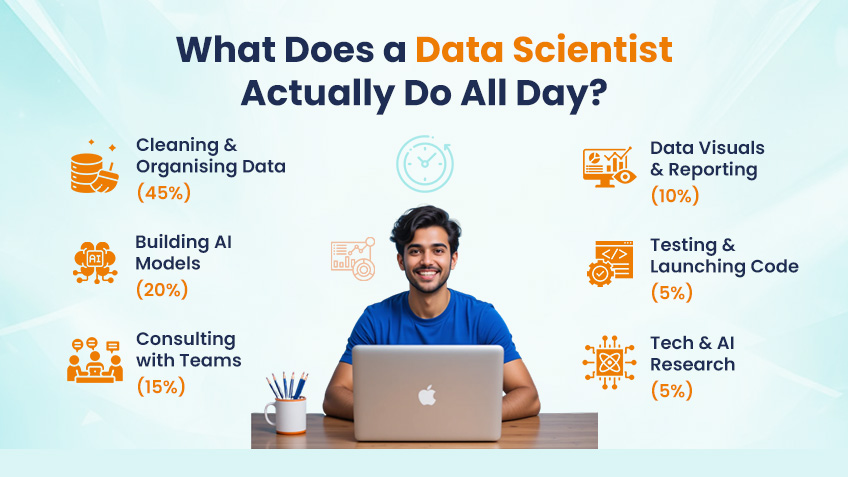
Today, data scientists do more than just write complex code. They use statistics, maths, and specialised software to uncover hidden data patterns that solve human problems.
Data scientists require skills include spending the bulk of their time turning messy data into clean, usable formats, ensuring that the AI models and visual reports they build are based on high-quality information. They create a balance of deep technical work and collaborating with teams to solve real-world business problems.
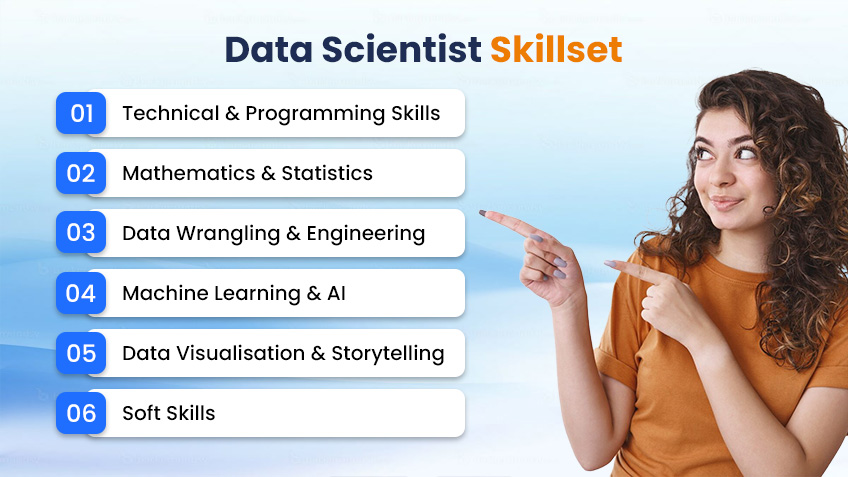
Neither do you need to be a genius in everything nor a degree for a data scientist, you just require a balanced combination of human intuition with expertise in AI tools.
Here are the key skills you need for data science.
Programming is your primary tool for effectively interacting with the data. Although many programming languages exist in the industry, the following are still the industry standards:
Python: You require proficiency in Python libraries like Pandas and NumPy for data manipulation and Scikit-learn for machine learning.
SQL: Structured Query Language is arguably the most crucial for daily tasks. You should learn to write complex queries to extract meaningful data from relational databases.
R Programming: R offers robust statistical packages and is recommended for heavy statistical research and academic environments.
Cloud Computing: Familiarity with AWS (SageMaker), Google Cloud (Vertex AI), or Azure is now a standard requirement for deploying models.
While you don’t require a PhD in mathematics, you must understand how math works so you get accurate results from messy data.
The real-world data is messy, biased, and not ready for use. Here, the data wrangling and engineering stage helps you transform scattered data into a usable format.
This is where you build models that can automatically learn patterns and make predictions. Machine learning and AI are the brain of the data science process.
Data is only valuable if people can understand it. Data visualisation & storytelling is the skill of turning complex numbers into clear, visual narratives.
It goes without saying that technical skills get you the interview; soft skills get you the promotion. Soft skills, also called human skills, allow you to function effectively within a business.
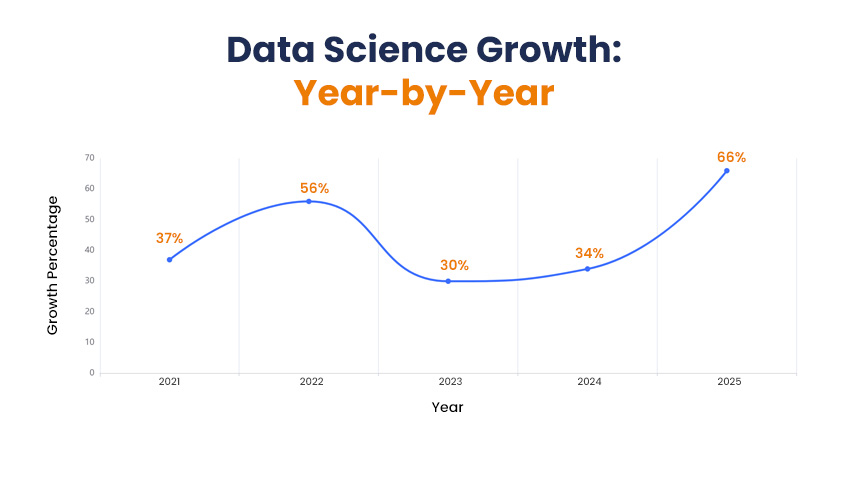
The data science job opportunities are exploding. This chart shows the massive annual growth in the demand for data science professionals, peaking at 66% in 2025 as AI becomes the top priority for businesses worldwide.
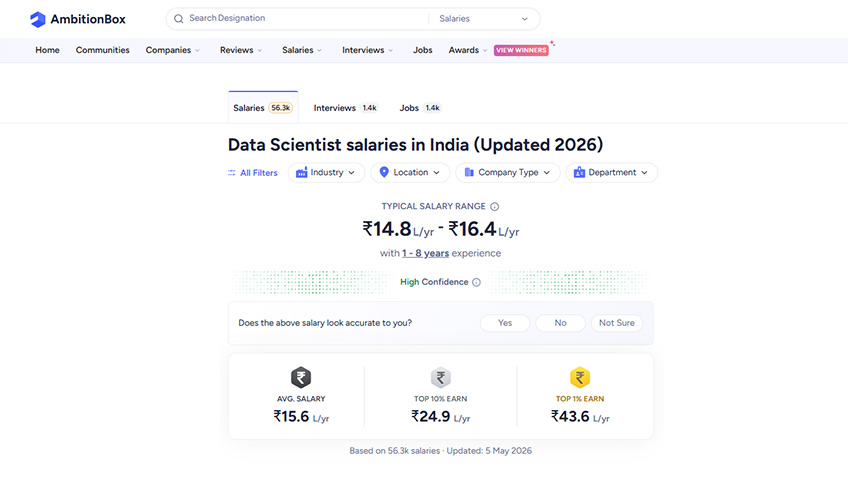
As of May 2026, data scientists’ pay in India averages ₹15.8 LPA, with top experts making over ₹43.5 LPA as the demand for advanced tech skills continues to surge.
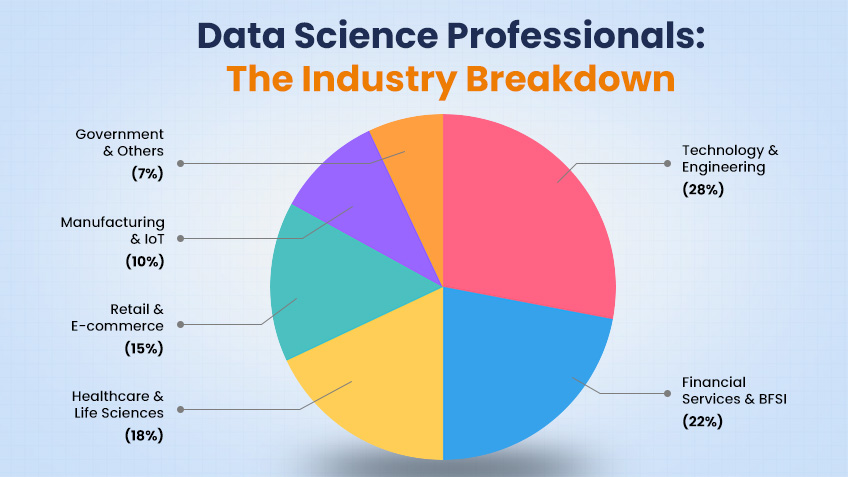
Now, over 70% of data science opportunities are found in various sectors like Finance, Healthcare, and Retail, proving that data expertise is essential for every industry.
| Job Role | Key Responsibilities | Average Monthly Salary in India |
| Data scientist | Uses math and AI to predict the future and solve big business problems. | ₹15.9 L – ₹68 L |
| Data analyst | Looks at past numbers to create reports and explain what happened. | ₹10 L– ₹25 L |
| Data architect | Decide which cloud tools and databases the company should use to stay fast. | ₹33.8 L– ₹64.7 L |
| Business Intelligence Analyst | Builds dashboards (like in Power BI) to help managers make quick decisions. | ₹9 L– ₹23 L |
| Data engineer | Make sure the data is clean, organised, and ready for the scientists to use. | ₹12 L– ₹40 L |
| Machine learning engineer | Teach computers how to recognise patterns, like spotting a fake credit card. | ₹11 L– ₹30 L |
Whether you’re looking for entry-level data science jobs or moving from data analyst to data scientist, this section simplifies your path in today’s AI-driven world.
Before you dive into complex AI, you need to build a strong base in data science. This includes getting comfortable with statistics and basic math. While you don’t need to be a genius, you should understand how to read data and identify patterns.
Data scientists use some specific tools to do their jobs. This includes Python programming language, SQL to talk to databases and pull out the needed information, and Tableau or Power BI to turn numbers into easy-to-understand charts.
Today, employers care more about what you can do than about your theoretical knowledge. Consider building a strong portfolio, which is a collection of projects you’ve worked on. For instance, you can find a dataset (like movie ratings or weather data), solve a problem/answer a question using that data, and then host your cleaned code on GitHub to showcase your logic.
While free resources are great, a structured program like our Data Science with Gen AI and ML course helps bridge the gap between basic theory and professional expertise. Karmick Institute’s data science course in Kolkata provides hands-on experience in cutting-edge fields like Generative AI and Machine Learning with the esteemed Vishlesan I-Hub, IIT Patna certification.
As data science is a vast field, specialising in a niche like healthcare, finance, or marketing makes you far more competitive. Becoming an expert in a specific industry increases your value, helps you command a top salary, and instantly makes you stand out to employers. Here, choosing the best data science institute is crucial to acquiring these skills.
Data science moves fast; consider staying ahead by following industry leaders on LinkedIn, testing your skills in Kaggle competitions, and attending meetups or webinars. Additionally, over 70% of tech roles are filled through referrals, so networking can also help you uncover job opportunities.
By now, you must have realised that while the path to becoming a data scientist is exciting, it requires the right data science career roadmap and structured learning to navigate successfully. Transitioning into this field is about mastering Machine Learning and Generative AI to stay ahead of the curve in a rapidly changing market.
Karmick Institute offers a comprehensive Full Stack Data Science with Gen AI and ML course designed specifically to turn beginners into industry-ready professionals. By providing structured learning, hands-on projects, and expert mentorship with prestigious Vishlesan I-Hub, IIT Patna certification, we help you start your journey in just 6 months.
Gain the skills needed to lead the next generation of data-driven innovation.
Call/WhatsApp today: 9836423755 | 6289562294 | 8910945693
How to Build a Career in Data Science?
Start by building a strong foundation, then mastering math and statistics, and learn a programming language like Python and the database tool SQL. From there, build a portfolio of real-world projects and complete a structured certification program in data science with Gen AI & ML to prove your skills to employers.
What is the difference between data science and data analytics?
Data analytics focuses on analysing past data to answer specific questions and help with current decisions. In comparison, data Science is broader, which uses advanced math and AI to predict future trends and solve complex problems.
Is data science a good career in India?
Yes, data science in India is one of the fastest-growing fields. The demand for skilled data professionals across industries, including finance, healthcare, and tech, makes it a highly stable and lucrative career choice.
What is a data scientist?
A data scientist is a professional who uses coding, math, and business knowledge to find hidden patterns in biased, cluttered, and messy information. They turn raw numbers into clear strategies that help companies grow or solve big challenges.
How long does it take to build a career in data science?
Data science typically takes 6 months to 1 year of dedicated learning to become job-ready. Our 6-month data science with Gen AI & ML course is designed to make you job-ready through real projects and top-notch training from industry experts.
Is coding necessary for a data science career?
Yes, coding is one of the data scientist required skills. It allows you to handle large amounts of data and build smart models that solve problems automatically. Learning beginner-friendly languages like Python or SQL is the best way to open doors to well-paying data scientist entry-level jobs.
What should I learn to start a data science career?
Your learning should be focused on three pillars: Statistics, Programming and Database Management. Once you acquire these skills, you can move on to Machine Learning and data visualisation tools like PowerBI or Tableau.
What is the best data science course?
The best data science course depends on your goals, but the top-tier options include the Karmick Institute’s Data Science with Gen AI and ML program. It offers prestigious Vishlesan I-Hub, IIT Patna certification, 100% job support, industry-aligned curriculum, and expert mentorship.
How do I know that data science is the right career for me?
If you enjoy solving puzzles, have a natural curiosity about “why” things happen, and like working with numbers to tell a story, then a data science career is the right choice for you.
Can a non-IT background switch to data science?
Absolutely! Many successful professionals start their data science career path from backgrounds like commerce, arts, or biology. Different domain knowledge is actually a huge advantage when it comes to understanding what the data actually means in a business context.
How much does a data scientist earn in India?
In 2026, the average annual salary for a Data Scientist in India is around ₹13.9 lakh. Freshers can start around ₹6–8 lakh, while experienced professionals at big tech firms can earn well over ₹25 lakh per year.
Read more blogs:


 Login
Login