info@karmickinstitute.com
 +919836423755
  +919836423755
Get up to 25% OFF on all IT courses Enrol Now Only 20 Slots Remaining! Limited Time Offer!
By Tanmay Das

The IT sector is anticipated to face significant job losses, potentially reaching 50,000 employees by year-end, according to projections from the Times of India. These job cuts in the IT sector are not simply due to a temporary economic decline, but are evidence of a deep, lasting structural transformation within the technology industry.
The old model of the Indian IT sector is fundamentally changing. Labour-intensive roles are being automated, and companies are increasingly restructuring and reinvesting.
Former MP Shashi Tharoor warned of an “IT apocalypse” where up to 5 lakh jobs are at risk in India.
Not just in India, according to a recent survey of 1,000 U.S. business leaders, the shift to AI is accelerating: nearly 3 in 10 companies have already replaced workers, and over a third (37%) plan to do so within the next year.
According to The Economic Times, factors like automation, AI adoption, and changing client needs have pushed Indian IT employee cost growth down to 5% in FY25, a significant fall from the 15% average recorded between FY19 and FY23.
Here’s the crucial pivot: for those who are prepared, this is not a crisis of employment, but an enormous opportunity for reinvention; but those who resist adapting their skills and relying on outdated knowledge will face significant challenges, displacement, and obsolescence in the modern workforce.
This blog is your survival guide, highlighting essential, actionable strategies you need to incorporate in your life to avoid layoffs and become an indispensable asset in the new world of Indian IT.
The short answer is: Yes, but it’s complicated.
While artificial intelligence and automation are playing a role in recent job cuts, it’s not the sole reason. Let’s understand this through simple case studies.
Challenge: A team of 10 junior copywriters in the marketing agency spent most of their time drafting routine ad headlines and basic email campaigns. This led to high labour costs and slow turnaround times.
Solution: The digital marketing agency integrated an AI-powered generative tool that could instantly draft thousands of basic ad variations and segment email copy. This reduced the need for manual drafting.
Impact: The agency’s productivity ascended, and they realised they only needed 4 senior strategists to manage and refine the AI’s output. This led to 6 layoffs because the repetitive tasks were automated, not the entire job function.
Challenge: A large company’s accounting department employed 15 bookkeepers & payroll clerks who manually reconciled bank statements, processed invoices, and flagged basic errors, which took a lot of time and were prone to errors.
Solution: They implemented RPA (Robotic Process Automation) combined with AI-driven document reading to classify transactions, match invoices to purchase orders, and run payroll calculations automatically.
Impact: The integrated system now handles 90% of the routine data matching and entry. The company shifted 5 clerks to higher-value roles, and the remaining 10 were laid off as their core, repetitive tasks were taken care of by the AI system.
Challenge: An IT company was spending too much money on its basic customer support team and needed to quickly reduce its budget to satisfy investors.
Solution: A new AI chatbot system was integrated that could answer 80% of common questions immediately.
Impact: The company is cutting labour hours by replacing the night shift support staff with AI chatbots. This layoff claimed it was adopting “future technology’ but in reality, it leveraged AI tools to save millions on salaries.

AI adoption is rapidly impacting jobs. Software leader Salesforce recently revealed it cut 4,000 customer support jobs because AI chatbots resolve half of all interactions.
CEO Marc Benioff stated, “I’ve reduced [support staff] from 9,000 heads to about 5,000, because I need less heads,” noting “50% of customer queries are now resolved by AI agents.”
Similarly, Chegg, an online learning platform, cut 45% of its staff (388 employees) after AI tools like ChatGPT reduced demand. Chegg is now shifting to an AI-powered model where algorithms will automatically answer student questions cheaply.
The transformative power of AI and economic pressures are among the major reasons for the recent massive IT job cuts. While many news headlines highlighted the enormous job cuts, the actual reasons are a mix of various factors, including:
The impact of AI on IT job cuts can be seen in primarily two areas:
The table below highlights that many IT roles are transformed by AI, not simply replacing them.
| Feature | Automation | Augmentation (Transformation) |
| Core Action | The machine or software replaces a human task entirely. | AI works alongside a human to make them dramatically better and faster. |
| Goal | To eliminate human effort for a specific, often repetitive, task. | To elevate human capabilities and boost productivity. |
| Impact on Job | Can lead to task redundancy (fewer people needed for that task). | Requires humans to move up the value chain (focus on strategy and problem-solving). |
| Example | An automated system running all nightly security checks without any human input. | A software developer using AI to write 40% of their code, allowing them to focus on complex architecture. |
| The Result | Focus on efficiency through replacement. | Focus on effectiveness through augmentation. |
India’s layoff wave is real. The IT jobs that are repetitive, rule-based, and highly standardised are most at risk. The table below highlights the roles that are at risk and the tasks that will be automated in that particular position.
| Role Category | Why is it at Risk? | Tasks Being Automated |
| Entry-Level Coding | AI can generate basic boilerplate code faster than a junior developer can write it. | Writing standard CRUD operations, basic API calls, and unit testing. |
| Certain Support Functions | AI-driven systems (chatbots, self-healing code) can resolve common issues without human intervention. | Tier 1 help desk tickets, password resets, and basic troubleshooting. |
| Manual Quality Assurance (QA) | AI tools can generate test cases, find bugs, and run massive automated tests much quicker than humans. | Repetitive manual testing, reporting minor bugs, and regression testing. |
| Basic Data Entry/Cleanup | These are routine data handling tasks that RPA and ML excel at. | Data cleaning, data formatting, and migrating data between systems. |
The New In-Demand Roles Created by Generative AI
As the advent of AI and automation has made several job positions redundant, it has also created high-value roles that require human creativity and strategic oversight. Demand for AI talent is likely to cross 1 million roles by 2026, but India faces an AI skill deficit of nearly 53%, creating opportunities.
Check for ‘Yes, No, or Not Sure’ for each given in the following layoff watch checklist.
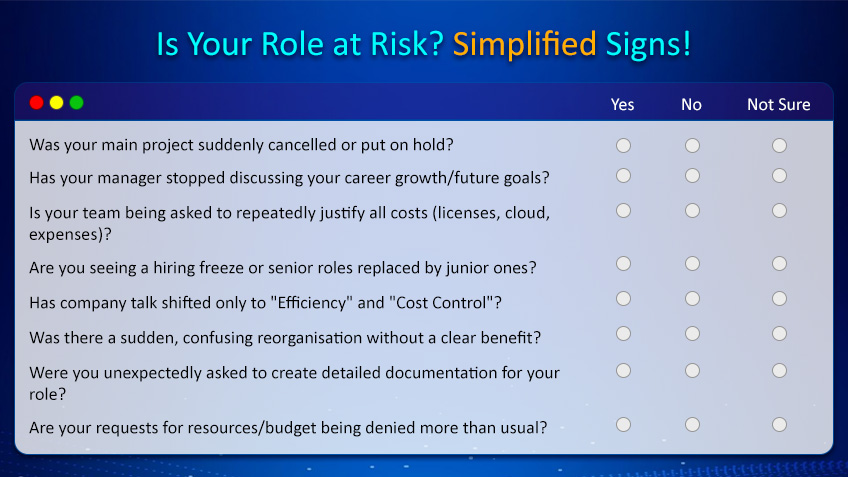
What’s your score?
Answering “Yes” to three or more of the questions above suggests it’s time to shift from passive employee to proactive career planner. Scroll down to learn the essential survival and ‘thrive’ strategies you need to implement today.
How to Survive and Thrive in This Layoff Wave?
This phase focuses on surviving the tech layoffs, making yourself an indispensable asset for your company and becoming prepared within your organisation.
Instead of working on typical projects, dedicate 80% of your time to those that directly benefit your company and contribute to the revenue, like cost-saving initiatives, core product features, security, etc.
Instead of saying you fixed the bugs, try ‘I reduced latency by 15% and saved up to ₹4,50,000 in cloud costs.
Make sure your highest-priority tasks are visible to your manager as well as the boss. Present your results in such a way that they contribute to business value.
Help your teammates with often-ignored tasks like think documentation, cleanup, and fixing broken processes. Companies value reliable fixers when the budget is tight.
Consider taking ownership of updating and cleaning up crucial system documentation. This will make you an essential asset to anyone who is taking over a project and also reduces onboarding time.
Connect with your former managers and colleagues discreetly. Initially, you should focus on exchanging value rather than just asking for help.
Make sure all the personal information, presentations, self-assessment roles, and performance reviews are saved off-site. Keep your resume updated and portfolio ready to get yourself noticed.
This phase focuses more on adapting to the new changes and evolving market by acquiring future-proof skills and preparing for long-term job security.
Focus your learning skills that cannot be replaced by artificial intelligence, especially those that need human intelligence, oversight, and ethical judgment, such as cloud security, AI governance, data science, MLOps, prompt engineering, etc.
Invest your money in getting the right courses and advanced certifications in top IT courses. Get certification related to AI/ML, like data science with Gen AI & ML course or full stack web development that proves your expertise to handle high-value tech stacks efficiently.
As anyone can be hit by layoffs, consider keeping a strong buffer of savings that can manage your 6 to 12 months’ expenses. Update your LinkedIn profile, add your new skills and review your financial and health insurance to reduce risk during tough times.
Consider dedicating time to learning and understanding new generative AI models. Take out time to learn what these AI models are and how you can integrate them into your workflow.
In the age of AI, continuous learning has become a daily responsibility, not a one-time task. Dedicate a certain amount of time each week to learn about existing and emerging AI tools and staying updated on the latest security and cloud threats.
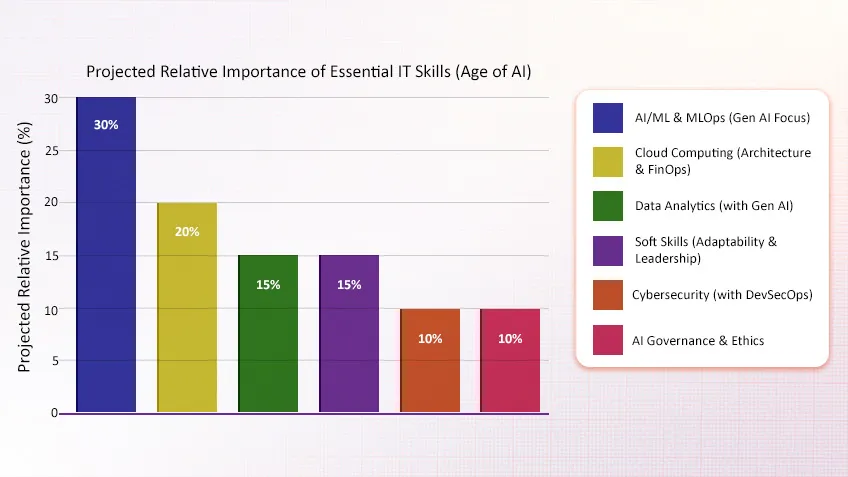
The following are the high-value skills to master in an age highly driven by artificial intelligence.
Mastering platforms like AWS, Azure, and GCP for scalable, resilient infrastructure is necessary for deploying AI models.
Protecting AI systems and the massive datasets they use from threats, focusing on AI-specific vulnerabilities and data integrity.
Using generative AI tools to extract deeper, predictive insights from complex data and create synthetic data for model training.
Skillfully integrating new AI tools into existing workflows while maintaining critical thinking, communication, and emotional intelligence in a hybrid environment.
Ensuring the efficient, reliable deployment and maintenance of AI and Machine Learning models in production environments.
Establishing and enforcing responsible frameworks and policies to guide the ethical development and deployment of AI solutions.
Other than cutting-edge tech skills, soft skills are truly irreplaceable human attributes that help in determining organisational success. These skills include critical thinking, adaptability, communication, etc. For a deeper dive into these essential human skills, watch this video.
Is AI responsible for layoffs? AI is the accelerator of change, not the sole cause of the current IT job cuts.
In summary, AI isn’t an evil robot taking a person’s place overnight. It’s a tool that increases productivity to such an extent that companies realise they can achieve the same output with fewer people, leading to IT job layoffs focused on roles dominated by repeatable,
What should we expect over the next two years?
Don’t just read. Now it is the time to act.
Due to a wave of layoffs and more predicted in the future, start your Phase 2 (Thrive Mode) journey today by choosing one advanced certification or in-demand skill from the list above and enrolling.
If you want to thrive, we can help!
Our in-demand, high-value IT courses not only equip you with sought-after skills but also prepare you for the competitive job market through dedicated placement support.
Book a free counselling session today: 9836423755 | 6289562294 | 8910945693
Is the Indian IT sector falling?
No, the Indian IT sector is not falling but going through a structural reset with massive growth in cutting-edge tech like AI and job displacement in various legacy roles. While the IT sector is facing challenges like skill mismatches and layoffs, it is projected to grow in 2026.
Are layoffs occurring in the IT industry in India in 2025?
Yes, layoffs are occurring, even the tech giants like TCS and Amazon have laid off many employees in 2025. However, these IT jobs layoffs are attributed to AI, automation and skill mismatch rather than entirely economic reasons, which are particularly impacting non-core and mid-level roles.
Will AI replace 50% of jobs?
It is highly unlikely that AI will replace jobs by 50% but the estimates are closer to 12% as tasks will be automated in advanced economies. AI is expected to transform or augment around 60% of jobs, which necessitates the need for upskilling and proficiency in this cutting-edge tech.
Will IT hiring increase in 2026?
Yes, IT hiring in India is expected to significantly rebound in 2026 with more job opportunities i specialised roles in AI, Cloud Computing, and Cybersecurity, with a significant skill deficit in these areas.
Is hiring slowing down in India in 2026?
Hiring is not expected to slow down in India in 2026. However, non-core/traditional roles may face a downturn, but hiring in high-demand IT sectors will continue to accelerate in future.
Which degree is the most unemployed in?
Humanities and social sciences graduates and post-graduates are the most unemployed in India, compared to those with degrees in STEM (Science, Technology, Engineering, and Mathematics).
Why is Gen Z struggling to get jobs?
Gen Z is struggling to get jobs due to a skills mismatch. Their education is not aligned with the market needs or industry standards, and perceived cultural misalignment with corporate culture, like immediate feedback, rapid rewards, and challenges in mental health needs with required accountability.
What is the hardest month to find a job?
The hardest month to find a job is December due to year-end holidays, senior managers’ vacations, and budget closers. Also, months of June, July, and August are considered months to get fewer jobs due to vacation-related slowdowns.
What degree is least employable?
The least employable or least ROI degrees are generally those in fine Arts, liberal arts, and humanities, as these fields lack technical specialisation, which employers seek in advanced education.


 Login
Login