info@karmickinstitute.com
 +919836423755
  +919836423755
Get up to 25% OFF on all IT courses Enrol Now Only 20 Slots Remaining! Limited Time Offer!
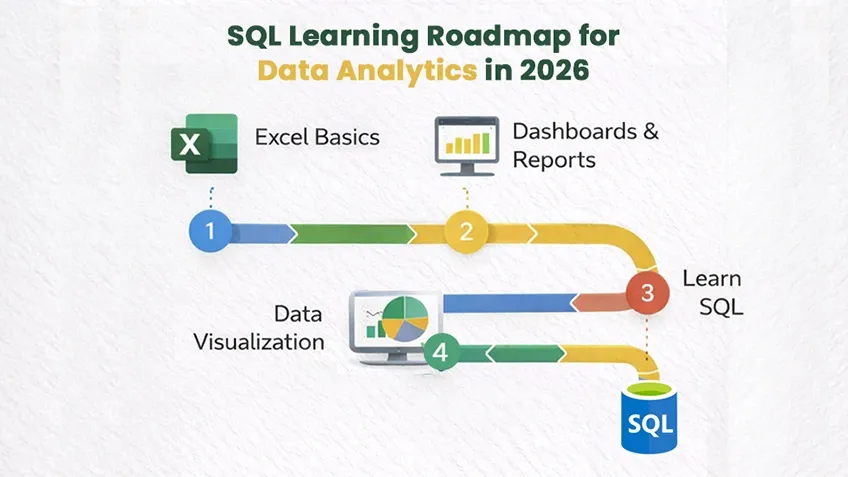
Want to explore how to learn SQL? This blog is your step-by-step guide to mastering this programming language. Let’s dive in!
Is it even worth learning SQL in 2026 when AI can efficiently ‘write the code’? We often get this question asked by many students, professionals, and career switchers. If you are also confused, here is the data you need to know.
The job posting for data analysts with SQL expertise has surged by 14%, especially with the growing integration of AI technologies.
Why?
Now, companies don’t just require someone to generate code; they seek people who can audit, optimise, and fix the errors that AI produces.
If you want to become a data architect from a prompt engineer and command a salary package that crosses ₹15 LPA, you need to master the language of databases. Here, SQL is your key that unlocks several career paths in data analytics across industries, including healthcare, finance, marketing, and many more.
Whether you’re a student looking for that first big break or a professional aiming to future-proof your career in an automated world, SQL is undeniably a non-negotiable skill to acquire.
This blog is your complete SQL learning roadmap. From what SQL is, why it matters, the skills you gain from this expertise, and a step-by-step guide on how to learn SQL, you will learn all the essentials in one quick read.
Let’s get started!
SQL stands for Structured Query Language. SQL is the standard programming language designed for handling and manipulating data that is held in RDBMS (Relational Database Management System).
Simply put, SQL acts as a universal translator between humans and databases. While Microsoft Excel is a file where you are required to drag and drop manually, a database is a huge, complex library.
Here, SQL is the language which walks you into this complex library effortlessly, finds the exact books you need, summarises each chapter, and presents the outcomes in seconds.
The SQL Server Transformation market is set to grow from $20.7 billion in 2025 to $54.2 billion by 2035, growing steadily at about 10% CAGR (Compound Annual Growth Rate) each year. Despite the rise of NLP (Natural Language Processing) and numerous AI tools, SQL remains the cornerstone for data analytics for many reasons, including.
In 2026, AI will be your assistant. While AI tools like Gemini or ChatGPT can write SQL code in seconds, they lack human common sense, which is very crucial for business.
AI tools often join incorrect tables or calculate the profit using a formula that does not apply to a specific company. Here, knowing SQL allows you to fact-check the AI’s logic and ensure the results are 100% accurate, making you an indispensable asset for any company.
While flashy data tools are launched in the market every month, most of them, including Snowflake, BigQuery, and even Excel’s advanced features, depend on SQL at their core.
If you learn SQL, you don’t need to master 10 different tools. With SQL, you can work for any industry, any company, whether a startup or a big firm, from anywhere.
AI often provides a summary, but businesses need accuracy. For instance, if companies ask for the top 5% of customers who bought a specific subscription in Delhi in the last 2 days, an AI tool might struggle with some filters.
With SQL, you just need to write a few lines of code, and you get the precise list in seconds.
The real-world data is messy, full of duplicates, scattered and hence not ready to use, which is why data wrangling is the most critical step in the pipeline. It is the art of auditing and perfecting data.
Here, SQL gives you control to clean data efficiently. Although AI is improving in this aspect, no tool can match the SQL precision of a well-written query.
Many professionals get stuck and frustrated when they fail to get the data they actually need. They have to submit a request, wait for the team’s response, and make sure they understand what they actually want. Here, SQL gives you independence.
You can talk directly to the databases, ask questions, and find insights that many have missed. Additionally, this analytical independence earns you a salary of ₹15+ LPA.
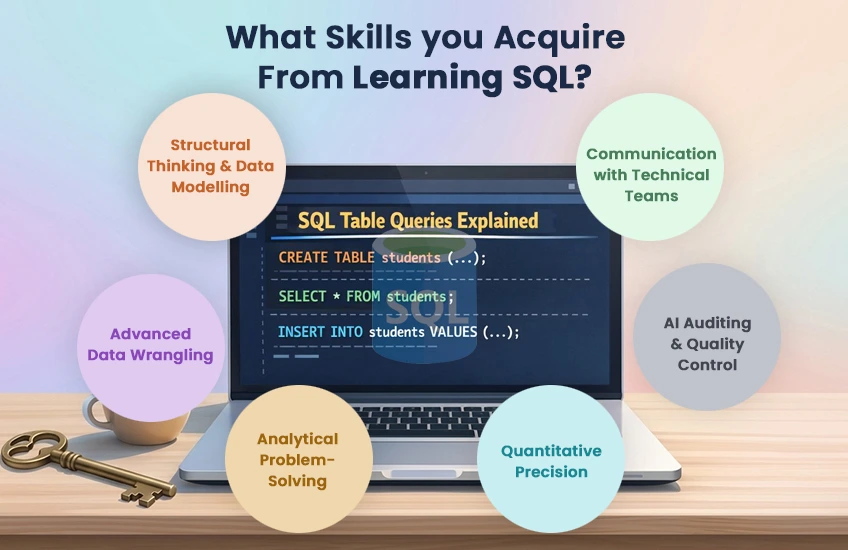
When you enrol in a high-quality SQL training online program, you gain sought-after skills, including:
SQL equips you with skills to see a messy pile of data as a structured system. You learn how different parts of businesses, like products, customers, and sales, relate to each other.
In 2026, the expertise to explain a Schema (how tables connect) is considered more valuable than writing the actual query.
If data is filled with duplicates, errors, missing values, and odd formats, SQL is a valuable tool for cleaning it. SQL equips you with skills to filter, join, and aggregate the data to turn its rawness into a clean analysis-ready dataset.
When you write a SQL query, you translate a vague, unclear business question into a logical set of instructions. SQL equips you with skills to break a big problem into small, solvable steps.
This logic applies to everything, whether you are building a Power BI dashboard, coding in Python, or even managing a team. This is why many seek to learn SQL for a data analysis career specifically.
SQL equips you with skills to calculate key business metrics such as CAC (Customer Acquisition Cost), churn rate, and year-over-year growth with total accuracy.
You master Aggregate Functions (SUM, AVG) and Window Functions (RANK, LEAD/LAG). In an AI-generated era, SQL allows you to produce numbers that are verifiable, traceable, and undeniably true.
As we already discussed, AI tools can generate code, but it lacks precision. Learning SQL gives you an eye to spot errors and ensure accuracy.
Working with SQL gives you the ability to read a query and spot places where logic fails. This very skill transforms you from just a mid-level professional who prompts AI to a director who manages AI.
Whether it’s data scientists, data engineers, or developers, all speak SQL language. By learning SQL, you don’t just become a tech worker but start collaborating with everyone. SQL equips you with technical literacy.
For example, you will understand terms like Primary Keys, Indexing, and Cloud Data Warehousing. This expertise enables you to explain what exactly you want from the IT team.
Learning SQL is like learning a new language. It is logical, structured, and once you get the hang of the syntax, SQL is incredibly satisfying.
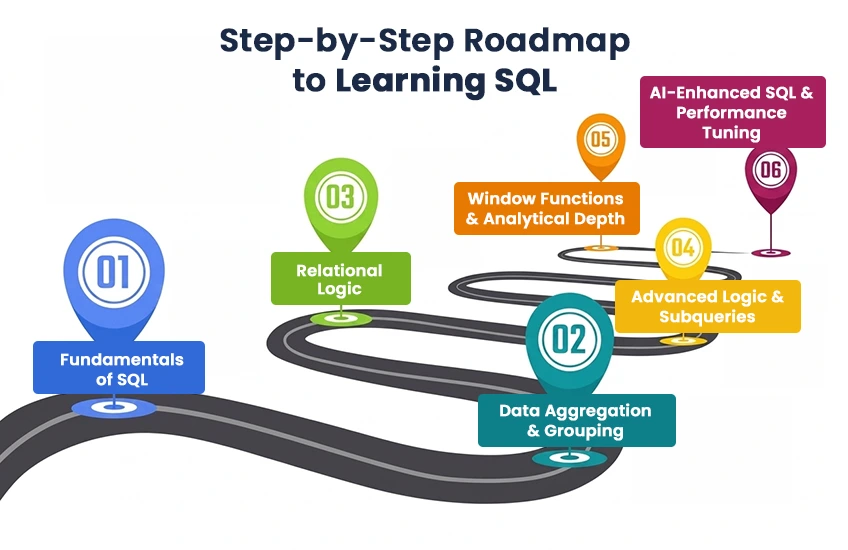
If you are wondering how to learn SQL, here is your step-by-step roadmap to mastering SQL and moving from basic queries to AI-driven data analysis.
In this first step, which is also called the discovery phase, you learn how to communicate with the database to extract exactly what you need. It’s about learning the basic vocabulary required to ask a database a simple question and filter out the clutter. This is a core part of any SQL training for beginners.
The next step is the summarisation phase, where you will learn how to “crunch” thousands of rows into high-level metrics. For example, calculating monthly revenue or total active users in a month. This allows you to find big-picture answers, like total monthly sales or the number of active customers, instead of looking at every single transaction.
This step is the connection phase, where you will master the art of “joining” separate tables back together using shared ID columns to see the full picture. This is necessary because real-world databases are split into many small, specialised tables to save space and maintain organisation.
This is the logic phase, where you learn to solve multi-step problems and use custom rules to label your data as you pull it. This allows you to create new categories like marking a customer as VIP or “Standard based on their spending habits.
This is the analysis phase, also the most powerful tool for a data analyst, which allows you to perform calculations across a set of rows (like rankings or running totals) without losing the detail of the individual rows.
This is the optimisation phase, where you must learn to write good code. In this step, you will use AI to debug your work and learn how to speed up slow queries that are “clogging” the system.
The rise of AI has not replaced the need for SQL; rather, it has contributed to the rising demand for clean data experts more than ever. To become a high-earning Data Architect in 2026, you must move beyond simply generating code to truly master the logic behind it.
At Karmick Institute, we don’t just teach you to write queries; we provide an intensive SQL course that trains you to lead AI in just 6 months. Our Data Analytics with AI course teaches you all the essentials of SQL and makes you ready for a career that grows rapidly.
Our SQL training within the Data Analytics with AI program teaches you all the essentials to make you career-ready. We offer the esteemed Vishlesan I-Hub, IIT Patna certification and a dedicated placement assistance cell that helps you build a high-paying career in data analytics.
So this was the ultimate guide on how to learn SQL. We hope you find this post helpful.
If you are looking for a comprehensive SQL course or specialised SQL training, your journey from learning SQL to mastering data with AI starts with us.
Join Karmick Institute today!
9836423755 | 6289562294 | 8910945693
Do I need coding knowledge to learn SQL?
No, you don’t need a background in coding. SQL uses English-like commands like SELECT, FROM, and WHERE, which makes it one of the most beginner-friendly languages to learn.
Which SQL database should I start with?
You can start with PostgreSQL or MySQL. These are used by millions of companies. Once you learn one of these, you can easily switch to others like Snowflake or BigQuery.
Is SQL enough for a data analytics career?
SQL builds a strong foundation for a data analytics career. Moreover, once you figure out how to learn SQL, you should pair it with Power BI/Tableau and basic Python.
What are the essential skills to learn SQL?
The most essential skill is logical thinking. You need to understand how to break complex business questions into small steps. Additionally, you should have knowledge of organising data in rows and columns.
How much time does it take to learn SQL?
SQL can take 4-5 weeks to learn basics like pulling and filtering data. To become a job-ready candidate with advanced techniques like Joins and Window Functions, it might take 3-4 months of consistent practice.
What is the difference between SQL and NoSQL?
While SQL is for structured data like an organised Excel sheet with fixed rules, NoSQL is for unstructured data like social media posts or messy documents that don’t fit into clear tables.
What are the career paths after learning SQL?
Learning SQL opens doors to roles like Data Analyst, Business Intelligence (BI) Developer, Financial Analyst, and Marketing Operations. As you gain more experience, you can move into high-paying roles like Analytic Engineering or Data Architecture.


 Login
Login