info@karmickinstitute.com
 +919836423755
  +919836423755
Get up to 25% OFF on all IT courses Enrol Now Only 20 Slots Remaining! Limited Time Offer!
Did you know that fewer than 55% of websites actually meet Google’s rules for a smooth and fast website (Core Web Vitals), and nearly half of them have simple mistakes like duplicate descriptions or broken links?
Many brands are losing traffic not just because their content is bad, but because their technical foundation is just not right. That is why numerous companies today are aggressively investing in candidates who understand the ins and outs of how search engines crawl and index web pages.
However, when breaking into the digital marketing field, most students focus on learning content creation and social media. But while everyone else is focusing on basic blogging, a high-paying gap is being left wide open, i.e., Technical SEO.
Industry data show that 45% of employers struggle to find skilled digital marketers, with technical skills like SEO and analytics identified as the hardest to find.
If you want to fast-track your career in digital marketing and stand out in a massive crowd of applicants, this technical SEO roadmap will provide the exact guidelines to turn you into a confident technical specialist.
Let’s dive in!
Whether you are just starting out or trying to land your first job, this digital marketing roadmap breaks technical SEO down into steps you can follow.
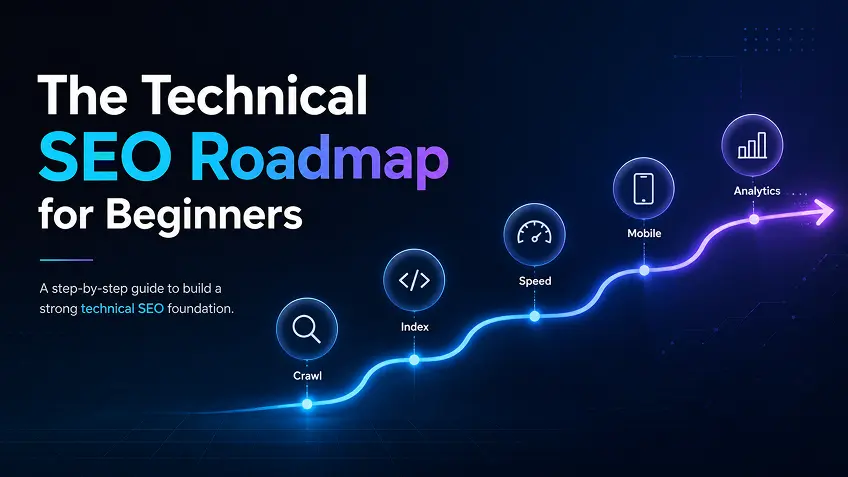
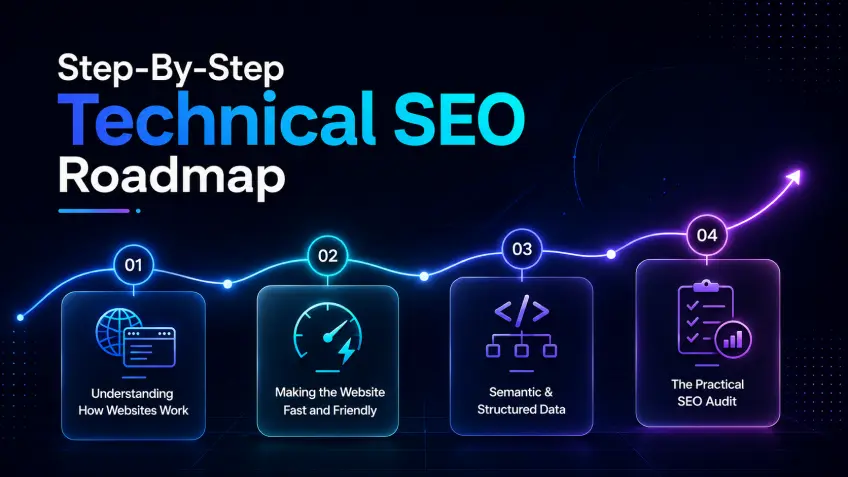
Before a search engine can rank a website, it has to find it, explore it, and save it seamlessly. If your website’s technical foundation is not right, even the best content will not rank because it will never show up on search engines.
When a website is messy or broken, search engines fail to understand, get confused and leave. A clean site architecture helps both users and search bots navigate your site without getting lost.
These are two separate steps that students often mix up:
Pro Tip:
How to use Google Search Console to spot indexing errors?
Open a free tool called Google Search Console (GSC) and look at the Indexing report. It will show you a list of pages that Google found but didn’t save. Learning how to see and fix these errors is a great skill that you can demonstrate in interviews.
Search engines want to take users to those websites that load more quickly and are easy to use. This means that if a website is slow or frustrating, its rankings will drop, for sure.
Google uses three specific measurements, i.e. Core Web Vitals, to analyse and score how friendly a website is for a user.
If a web page takes too long to open, visitors don’t think twice before hitting the back button. As a technical SEO student and a learner, optimising Page Load Speed is a critical skill. You can use free tools like PageSpeed Insights to find what aspects or elements are slowing a site down. It can be huge image files or messy code, and fix it.
Not only the speed, but search engines also look at the mobile version of your website to decide how high to rank you under mobile-first indexing. If a website looks amazing on a laptop but breaks on a mobile screen, its rankings get negatively impacted.
Phase 3: Semantic & Structured Data (The AI-Ready Skills)
Search engines now use artificial intelligence to give direct answers to users, a shift from SEO to GEO (Generative Engine Optimisation). Technical SEO includes formatting your data so these AI tools can read and understand your website perfectly.
Schema Markup is a simple piece of code that tells the search bot exactly what a page is all about. Knowing how to use basic code shows employers that you can help websites get special search features, like star ratings or price tags, right on the Google results page.
Many of you will agree that the biggest problem for students is not having job experience. Fortunately, you can beat this problem by running a comprehensive SEO audit. You can do a website checkup on your own to show to future employers.
You can do an audit of your website with these tools:
Pro Tip:
Don’t just hand a giant spreadsheet of numbers to a hiring manager. Put your notes into a short, clean document. Structure it simply: The Problem → Why It Impacts the Business → How to Fix It. Presenting your findings this way proves you know how to execute a professional SEO roadmap strategy.
Now, you know what you need to do to break into technical SEO. But the main goal is to convert the knowledge into a high-paying salary. Here is exactly what you need to do to transform your technical skills into a rewarding career.
Valuable Resume Tips
Stop using boring phrases like “I have experience in SEO” on your resume. Use specific, technical words that prove you actually know how to do the job:
In an entry-level marketing interview, be ready for simple problem-solving questions like:
Q1. What is the difference between a 301 and a 302 redirect?
A. A 301 is a permanent move to a new web address; a 302 is just temporary.
Q2. If a page disappears from Google, what do you check first?
A. Check the Robots.txt file to see if bots are blocked, or look for an accidental “noindex” tag hidden in the code.
While teaching yourself the basics through blogs and videos is a great start, landing a job requires structured, hands-on training that employers seek. If you want to fast-track your resume to stand out in the competitive job market, getting a premium certification can be a big game-changer.
Karmick Institute’s Vishlesan I-Hub, IIT Patna certified Digital Marketing with AI course equips students with hands-on experience through working on live websites. In this course, you master advanced technical tools and understand how modern AI search engines operate.
Combining your passion with an IIT-backed certification is the fastest way to prove to hiring managers that you have the technical SEO expertise that they are looking for.
Technical SEO isn’t just about code or complex software; it is about making the web faster, smarter, and better for every user. Mastering technical SEO gives you a massive competitive edge.
If you want to master this technical SEO roadmap without falling behind, check out Karmick Institute’s IIT-backed advanced digital marketing course in Kolkata with AI course.
Our hands-on training will help you build a flawless portfolio and gain the exact job-ready skills employers are actively hunting for. The digital marketing world is aggressively looking for specialists. Take action and start your journey today!
Call us now: 836423755 | 6289562294 | 8910945693
What is technical SEO?
Technical SEO is the process of optimising a website’s backend code and server setup so search engines can easily find, read, and save its pages. It focuses on site speed, mobile-friendliness, and clean site structure rather than content.
Why is a technical SEO Roadmap important for beginners?
A technical SEO Roadmap acts as a step-by-step guide for beginners. It helps you prioritise complex tasks like fixing Site Architecture or mastering Core Web Vitals, ensuring you develop job-ready skills efficiently without getting overwhelmed.
Does technical SEO pay well?
Yes, technical SEO is one of the highest-paying specialities in digital marketing, running from ₹3 LPA to ₹20+ LPA depending on the experience, location, and company working with. Because it requires specialised skills like data structuring and speed optimisation. Companies pay a premium salary for these skills, as these professionals solve complex website errors.
How much time does it take to learn technical SEO?
With consistent study, you can understand the core fundamentals of technical SEO in 2 to 3 months. However, mastering the hands-on tools, advanced coding scripts, and live website auditing usually takes 6 months to 1 year of practical experience.
Is learning technical SEO worth it in 2026?
Absolutely. In 2026, with the rapid rise of AI search engines and strict web performance standards, companies desperately need experts who can make websites readable for both humans and AI models.
What does technical SEO do?
A technical SEO specialist audits websites to find and fix backend errors. He/she executes the SEO roadmap strategy to find and fix backend errors, improve Page Load Speed, manages sitemaps, and implements structured data code. Their main goal is to make sure nothing stops search engines from crawling and indexing the site.
What is Mobile-First Indexing?
Mobile-First Indexing means that Google mainly uses the mobile version of a website’s content for indexing and ranking. Since the majority of users access the web via smartphone, your technical strategy must prioritise mobile performance.
Is technical SEO difficult?
It has a slight learning curve because it involves dealing with website logic, data structures, and basic code. However, it is not very difficult, as it can be learned in a few months.
Is SEO a technical job?
SEO is a job that combines creative content writing with technical website management. While traditional SEO focuses on keywords and blogging, Technical SEO is entirely a technical role focused on frontend performance and site architecture.
How much can an SEO earn in India?
In India, entry-level SEO executives generally earn between ₹2.5 and ₹4 Lakhs per annum. However, skilled technical SEO specialists and managers with a few years of experience can easily command salaries ranging from ₹8 to ₹15+ Lakhs per annum.
What is the first step in an SEO audit?
The first step in a professional SEO audit is checking a website’s crawlability and indexability. This means ensuring search bots can read your site architecture and that your important pages are free from code blocks.
Will technical SEO exist in 5 years?
Yes, but it will continue to evolve. As traditional search engines merge further with conversational AI platforms, technical SEO will shift even more toward data structuring and optimisation for generative AI engines.

Prasenjit Das is a results-driven digital marketing analyst who offers practical guidance on mastering digital marketing. He equips learners with the practical skills needed to excel in today's competitive market.


 Login
Login