info@karmickinstitute.com
 +919836423755
  +919836423755
Get up to 25% OFF on all IT courses Enrol Now Only 20 Slots Remaining! Limited Time Offer!
By Tanmay Das

Is it still worth it to learn AngularJS in 2026? The short answer is– yes, if your goal is to become job-ready and start earning faster. Now, your next potential query might be why should I learn AngularJS in 2026? The answer is if you want to earn a high salary, a future-proof job, and a rapidly growing career, then you should start learning AngularJS in 2026 without a doubt.
Let’s understand why!
Despite the retirement announcement years ago, AngularJS is still a significant pillar of the enterprise web, with over 1.3 million live websites relying on its architecture.
Originally developed by Google, AngularJS is a front-end JavaScript framework widely used in thousands of enterprise and legacy applications worldwide. With a salary ranging between ₹6 LPA and ₹8.7 LPA, learning AngularJS can build a high-paying career and actually fast-track your future in software engineering.
If you are still not convinced, this guide includes all the essentials and details about AngularJS and why enroling in the AngularJS full course can be a smart career move for students, freshers, and even seasoned professionals.
Let’s dive in!

AngularJS is a framework that allows developers to use SPAs (single-page applications) with less code. You can think of AngularJS as a developer’s personal assistant that makes website building very easy. The best thing about this framework is the ‘two-way data binding’ feature, which keeps the brain and face of the application aligned and in constant conversation with each other.
Traditionally, when a user typed their name in a box, developers were supposed to write specific code to grab that text and move it to the database. Additionally, if the database were changed, developers would do more coding to push that change back to the screen. With AngularJS, the entire process has been automated.
Although AngularJS has been retired after surviving for decades, it still remains a crucial part of development and powers a huge portion of the digital infrastructure across the globe. The logic is simple: the longer something has survived, the more likely it is to keep surviving. The following sections highlight why AngularJS training is still a high-value investment:
Big companies, including banks and government bodies, prefer staying with a cheaper option to keep the old system running than to build a new one. Additionally, replacing complex platforms costs millions, so businesses choose stability over keeping up with the latest trends.
Specialised companies now sell “security insurance” to keep this old software safe from hackers. AngularJS experts provide updates and custom patches that the original creators don’t offer now, which again contribute to their demand. You can learn these in-demand IT skills from AngularJS training online and implement custom patches to keep software safe from hackers.
Since new students don’t learn AngularJS, a very few people who still know AngularJS are like highly-paid vintage experts. As the number of AngularJS experts is decreasing, their value to maintain the legacy system is increasing.
AngularJS experts perform behind-the-scenes updates to ensure older applications continue to function correctly as modern browsers like Chrome and Safari evolve. This prevents websites from breaking when users update their browsers to the latest version. This ensures jobs for Angular developer specialists remain stable.
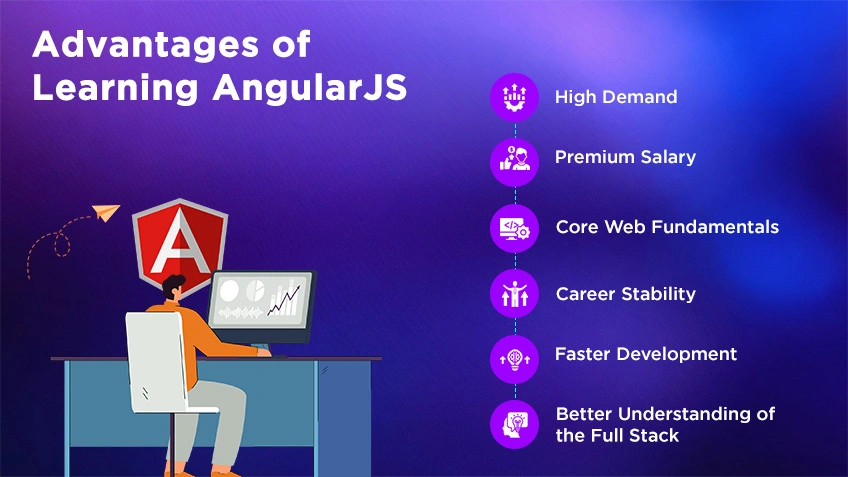
While many developers prefer to learn only the newest & trending frameworks, those who master AngularJS step into the ‘legacy economy’ where their skills are essential for maintaining the massive, stable systems that run global businesses. The following highlights why learning AngularJS is a great career choice.
Although various developers focus more on the latest trends, a massive portion of corporations still runs on AngularJS worldwide. This has created a huge gap in demand and supply, which means learning AngularJS in 2026 can make you an indispensable asset for top-tier companies. This is a primary reason the AngularJS career scope 2026 is so strong.
As a few people are learning AngularJS, it has created a major gap between demand and supply for this expertise. This gap has contributed to the high salaries of AngularJS developers, with an average starting salary ranging from ₹6 LPA to ₹8.7 LPA in India. Companies with massive, existing systems are willing to pay a premium package for specialists who can safely maintain their old digital assets.
An AngularJS full course teaches the strict MVC structure, making it the best way to learn Angular (the newer versions) or React later on. You gain knowledge of the complete in and out of web applications. AngularJS’s strict Model-View-Controller (MVC) structure helps in building a deep logical foundation, which makes it much easier for you to master any other framework in the future.
AngularJS is the backbone of internal tools across various sectors, including banking, healthcare, and government. These sectors prioritise long-term stability over latest updates. This means, if you learn AngularJS, top companies in these sectors will be ready to pay and keep you no matter what, offering recession-proof job security.
AngularJS is incredibly efficient for building quick dashboards or data-heavy internal forms. If you master AngularJS, the “all-in-one” feature allows you to build functional tools without connecting multiple modern libraries.
Learning AngularJS provides a clear look at how MVC architecture synchronises user interfaces with server-side data. AngularJS training is among the top job-oriented courses after BA, which builds a foundational understanding of the entire web stack, which simplifies your transition to any modern framework.
When you are starting out your career in this field, the biggest point of confusion is whether you choose AngularJS or Modern Angular, as both are considered the same. Many search for the best Angular training without realising that AngularJS and Modern Angular are different. However, both are completely different tools. Let’s look at the key differences between AngularJS and modern Angular.
| Feature | AngularJS | Modern Angular |
| Main Tech | JavaScript | TypeScript |
| Logic | Controllers & Scopes | Components |
| Speed | Moderate (Best for desktop apps). | High Performance (Best for mobile/apps). |
| Salary (Average Annual Pay) | ₹6 LPA and ₹8.7 LPA | ₹7 LPA and ₹9.7 LPA |
| Demand | Scarcity Demand: High requirement for the people who still know and have expertise to maintain the old systems. | Volume Demand: Thousands of job openings for building new startups. |
| Career Paths | Legacy Systems Architect Migration Specialist Application Reliability EngineerLegacy Security Consultant | Frontend Product EngineerFull-Stack Angular DeveloperEnterprise UI Architect |
Karmick Institute is one of the top IT training centres in Kolkata, offering ‘career-first’ AngularJS training. Our AngularJS course offers several professional and career development benefits, including:

At Karmick Institute, our AngularJS course is designed for actual industry use. Our training in AngularJS bridges the gap between theoretical knowledge and professional web development. We don’t just focus on theory, but on real usage that companies expect from junior developers. Here is a quick elaboration on what key AngularJS concepts are covered in the curriculum.
AngularJS may not be the newest framework in 2026, but it is still a highly practical and job-relevant technology.
If you want to enter the IT industry faster, build a strong front-end foundation, and start earning, then learning AngularJS is a smart and realistic step.
Through real projects, expert mentors and career-focused training, we ensure you become an AngularJS expert, no matter what your academic background is.
So, don’t wait anymore.
Join the AngularJS course at Karmick Institute and build your front-end skills. Take your first step towards a professional web development career today.
Contact us: 9836423755 | 6289562294 | 8910945693
Is learning AngularJS still useful for new developers?
Yes, because AngularJS makes you eligible for various specialist roles with a high-paying salary. While many choose to learn trending tools, AngularJS makes you a rare expert who is capable of maintaining the massive, high-value systems that big companies still rely on.
Why do we need AngularJS?
Several companies, including banks, hospitals, and government bodies, require AngularJS to keep the “hidden engines” running smoothly. AngularJS is still the solid base for massive systems that are just too big and too expensive to start over.
What should I learn, Angular or AngularJS?
Learn Modern Angular if you want to build new startups and mobile apps. Learn AngularJS if you want to work as a high-paid consultant or architect for established corporations to manage their massive existing software.
What is the salary of AngularJS?
In 2026, AngularJS specialists earn a starting salary of around ₹5.6 Lakhs per year. Additionally, as the skill is rare, companies pay significantly more to attract the few experts who still have expertise in this field.
Do companies still hire AngularJS developers?
Absolutely. Large enterprises and government bodies actively hire AngularJS developers to maintain, secure, and slowly modernise their core, old platforms. This demand offers better job security than tech startups.
Does knowing AngularJS help you learn newer tools like React or Vue?
Yes, learning AngularJS provides a perfect logic map for all modern web tools. Once you master AngularJS concepts like Two-Way Data Binding and Dependency Injection, learning React or Vue becomes much faster.
Why pick AngularJS as a Career Option?
The biggest advantage of choosing an AngularJS career is that it has very little competition with a high earning potential. AngularJS expertise makes you a rare, essential expert for high-stakes, traditional systems of top companies that must stay online.
What is the scope of AngularJS in the IT field?AngularJS career scope 2026 is less about building new apps and more about managing the important existing software. AngularJS has evolved from a development tool into a management tool, which helps companies keep their massive, older systems running smoothly while they slowly move toward the future of web technology.


 Login
Login