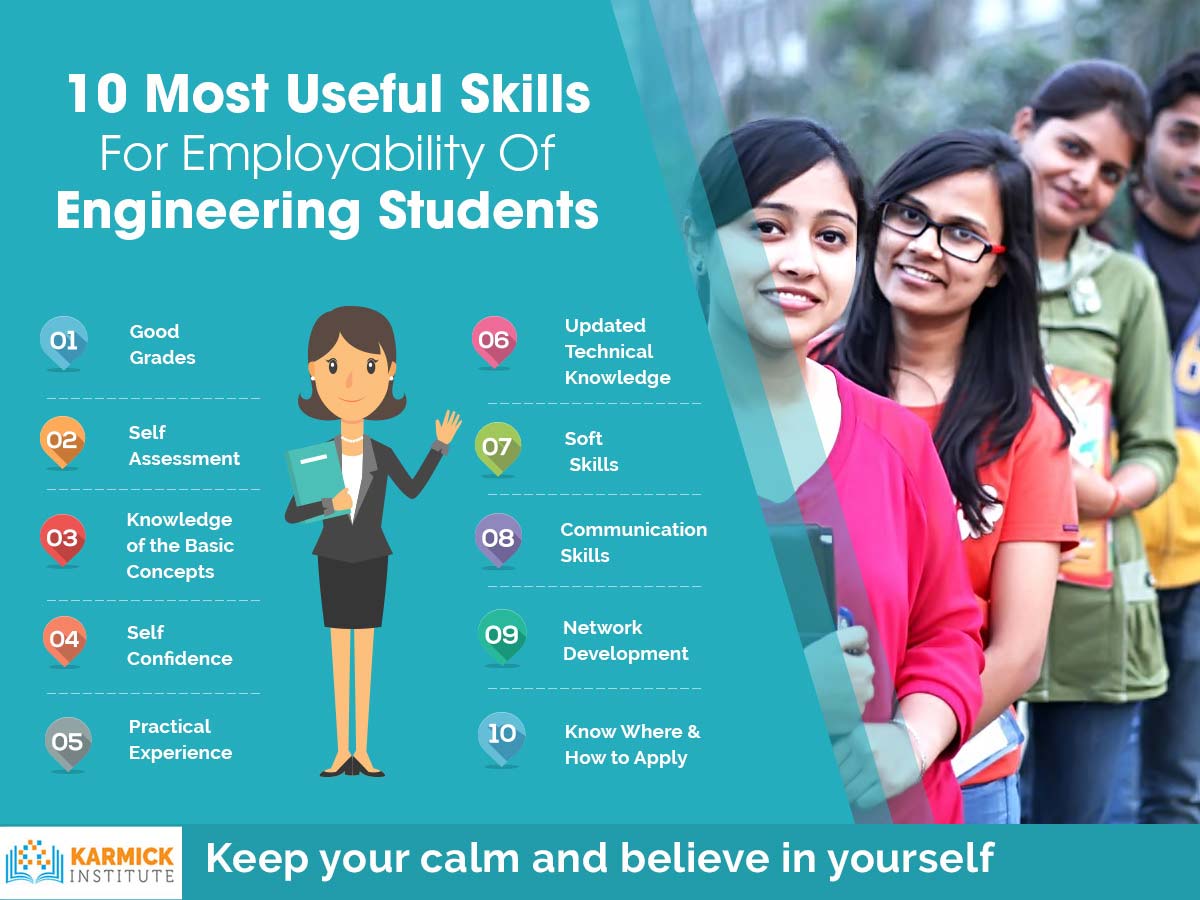
Want to know the most useful skills for employability after engineering? From AI & automation, system thinking, to data literacy, this blog dives into the 10 essential skills you need to master as an engineering student to boost your employability and land that high-paying job!
Ever wondered why some engineering graduates land jobs immediately while others struggle despite having impressive grades? Many students think a high GPA (Grade Point Average) is the only thing that matters, but in the real world, acquiring an engineering degree is just the starting point.
Today’s top engineering firms are looking for a mix of technically smart candidates with ‘people skills’ that textbooks often lack.
Preparing for the engineering exams and passing them with flying colours is indeed a battle-like experience for the students. Even before you get over the exhaustion of the exam preparations, you start feeling the pressure of finding a job in a company to make your degree fruitful.
To make the job-finding process less frustrating and more result-oriented, engineering students must develop a specific set of skills in the age of AI. This blog post curates 10 essential skills that significantly boost the employability of engineering students.

The World Economic Forum estimated that with new technology reshaping the industry, 50% of employees will soon require upskilling. In fact, more than 65% of today’s most critical job skills will likely be obsolete or entirely redefined in just five years.
Beyond a standard degree, acquiring specialised skills is essential for engineering graduates for the following reasons.
The curriculum of universities often lags in rapid technological shifts. The tools that you learned during the engineering might or very likely become obsolete by the time you acquire the degree. This is why learning specific industry tools ensures you can start working effectively on day one without needing extensive basic training.
As technology evolves, engineering challenges have become more complex. Here, learning specialised expertise is the primary driver of a premium paycheck. For example, an electrical engineer who masters Data Analytics with AI can interpret the massive data sets that those circuits collect to drive business value (more than just design circuits).
This dual expertise makes you much more valuable to employers because you can provide both the technical design and the smart insights, making you highly-payable.
Traditional engineering is often limited to a single discipline. As modern projects involve many moving parts, engineers who understand things and work outside their fields are often preferred by the companies.
For instance, a mechanical engineer who can code is much more useful to a team as they can bridge the gap between different departments.
Employers view additional certifications and self-taught proficiencies as tangible evidence of a proactive mindset. In an era defined by rapid AI integration and automation, technical tools can become obsolete quickly.
By staying ahead of industry shifts, you prove to recruiters that you possess the capability to adapt to new evolving technologies.
Technology changes so fast. Now, most modern engineering challenges require more than one type of expertise. Projects now require engineers who can speak multiple technical languages.
For example, an electrical engineer who understands Data Analytics can interpret the data that those circuits collect. Having these skills helps you stay relevant in a world where everything is becoming automated and digital.
As artificial intelligence increasingly automates routine technical tasks and complex data analysis, the role of the engineer is shifting from manual calculation to AI-augmented oversight.
To remain indispensable, students must master AI literacy and machine learning applications specific to their field.

The following is the list of must-have skills for engineering students to acquire a job easily and remain competitive in the market.
In 2026, the engineering field is more about partnering with smart systems. You must master ‘augmented engineering’ that involves understanding Gen AI and using it to automate repetitive tasks, write more efficient code, and optimise complex geometries via generative design.
If you want to be highly employable, learn how to prompt, refine, and integrate AI tools into old engineering workflows to increase output.
The rise of the IIoT (Industrial Internet of Things) has turned every machine into a source of generating data. Today, employers seek engineers who can understand this data and leverage tools such as Python, SQL, and Power BI to drive decision-making.
Now, it is not just about collecting numerical data; it is more about performing statistical analysis to forecast the failure of equipment, optimise supply chains, and transform raw sensor data into actionable insights.
While theoretical knowledge builds foundational skills, your job-readiness is measured by how quickly you can use professional software like SolidWorks, Revit, or MATLAB.
As these tools are industry-standard, your proficiency in these without requiring extensive on-the-job training makes you a highly employable engineer.
Today, modern engineering projects are interconnected webs where one change can affect several components of an ecosystem. Here, systems thinking is about thinking of the big picture and understanding these interdependencies.
If you want to become a highly employable engineer, you need to balance localised technical performance with the overall safety and efficiency of the entire multi-disciplinary system.
If you don’t manage well, even the greatest of your ideas can fail. This is why employers seek engineers who can organise methods like Agile or Scrum to stay on track. Here, you require ‘product thinking’, which is the ability to focus on what the customer actually needs while keeping an eye on the budget and deadlines.
Problem-solving and strategic analytical thinking are the ability to break down a complex issue into smaller, understandable parts to find the best solution. It means you use logic and data to identify exactly why a problem is happening and what the most efficient method is to fix it.
These skills are highly valuable and employable because it shows you can handle unexpected challenges independently and make smart decisions under pressure.
Theoretical knowledge is not enough to impress employers. This is because theory proves that you have learned, but a portfolio of practical projects shows you can do it. You can gain real-world, practical experience through internships, hackathons, and lab research, which again provides proof of your skills to employers.
Hands-on experience shows employers that you can handle real-world challenges like hardware failures, budget cuts, and conflicting requirements.
A high percentage of engineering students get lost or trapped in the labyrinth of words. To express yourself and explain what you are capable of, you need words. As a successful engineer, you need to seamlessly collaborate between technical teams and non-technical stakeholders like clients, marketers, and executives.
You need to build the skills to write clear technical reports, deliver persuasive presentations, and work effectively in diverse, cross-functional teams. Clear communication ensures that technical requirements are understood and costly misunderstandings are avoided in projects.
For engineering students, networking can greatly contribute towards career longevity. It is the social networking age, so create your network. Networking is the practice of building genuine, mutually beneficial relationships with industry peers, mentors, and alumni to stay informed about emerging technologies and unlisted job opportunities.
Keep in touch with your batchmates, seniors and professors to receive news on employment opportunities. Also, create a professional LinkedIn profile to get updates on job openings and get exposure to important tools, even people.
Technologies keep changing; many tools learned in the first year of college may be obsolete by graduation. Be an avid reader of blogs, journals, magazines, articles and anything you can lay your hands or eyes on. Apart from gathering the latest information on your area of specialisation, read other interdisciplinary articles as well.
Engineers who stay current with industry journals and show a willingness to expand their expertise are high-value long-term investments for any firm.
Pro Tip:
Self Assessment: Identify your weaknesses and strengths. Work on your weak points and even harder on your strengths. In an interview, when you’re asked, “Introduce yourself,” don’t just list your degree; highlight the specific skills that set you apart from other candidates. Use this moment to connect your personal strengths to the company’s needs, turning a simple introduction into a compelling reason to hire you.
While studying in classrooms provides a good foundation for engineering, gaining hands-on experience requires specialised training on tools. As an engineering student, you can build these essential in-demand skills through various real-world platforms, including:
Taking an internship is one of the best ways to see how engineering works in a real-world setting. When you work alongside experienced professionals, you learn to use industry-standard tools and software that the company uses, which aren’t included in engineering books.
Specialised IT training centres like Karmick Institute play a crucial role in bridging the skill gap between theory and practice by offering industry-aligned certification IT programs.
Our 6-month short-term courses offer practical-focused training in cutting-edge tools, giving students the experience that traditional degrees often lack. By earning the prestigious Vishlesan I-Hub, IIT Patna certification, you gain a verified credential that proves you are job-ready and highly proficient in modern engineering tools.
Consider participating in hackathons and design challenges, as it pushes you to build a working prototype or solve a complex problem in a very short time.
These events are great for building skills as they often require combining coding, hardware design, and teamwork. These competitions help you prove that you can deliver results under pressure.
Networking is very crucial to learn new things and even to secure a job that is not posted on recruitment platforms. Consider attending seminars, industry meetups, and related events because it allows you to learn current trends directly from top professionals.
This way, you can find out what skills and tools are in demand, making you more employable in today’s AI-driven era.
In this rapidly evolving industry, just acquiring an engineering degree is like building the foundation. Your true employability is defined by the ability to integrate your technicality with today’s in-demand skills like AI fluency, data literacy, and cross-disciplinary collaboration.
So, start acquiring these skills and give a significant boost to your engineering career.
Call or WhatsApp us today!
9836423755 | 6289562294
What skills do engineering students need to build a successful career?
A successful engineering career requires a mix of hard skills like technical proficiency and data analysis, and soft skills, such as teamwork and communication. Being able to adapt to new technology and solve complex problems logically is what truly sets you apart.
Which skill is best for engineering students?
While all skills matter, problem-solving is the most important. It is the core of engineering; if you can break down a difficult challenge and find a reliable, cost-effective solution, you will always be in high demand.
Are internships important for students in the field of engineering?
Yes, internships are vital because they provide practical experience that you cannot get from a textbook. They allow you to apply your classroom knowledge to real-world projects and are often the fastest way to build a professional network.
Does securing good grades provide a good opportunity to land a good engineering job?
Good grades are helpful for passing the initial screening, but they aren’t everything. Employers today prioritise your actual skills and practical experience; a student with average grades and strong technical projects often has a better chance than one with a 4.0 but no practical skills.
What engineering skills do employers currently seek?
Employers are looking for “job-ready” graduates who understand industry software, project management, and basic coding. They also highly value human skills, like leadership and the ability to explain technical ideas to people who are not engineers.
Is product thinking only for software engineers?
No, product thinking is essential for all engineers because it focuses on solving user problems and understanding the market.
How often should I update my skills to stay employable?
Upgrading skills is not a one-time task, as it is a continuous process. Consider evaluating industry trends every six months and learning at least one new tool or methodology annually to keep pace with rapid technological shifts.
Can I develop practical experience if I can’t find a high-paying internship?
Absolutely! You can build significant experience by working on open-source projects, participating in hackathons, or building your own personal engineering projects at home. Even industry-aligned advanced certifications at Karmick Institute provide hands-on proof of your abilities to future employers.
Where can I find industry-specific training that college doesn’t provide?
Karmick Institute offers job-focused, practical training in top IT programs that are specifically designed to meet current job market demands. We offer expert mentorship with Vishlesan I-Hub, IIT Patna certification in sought-after skills that help you boost your employability.
Why is data literacy becoming a requirement for non-software engineers?
Today’s engineering projects use sensors and automation to collect huge amounts of data. As an engineering student, if you acquire data literacy skills, you can use your expertise to identify problems before they happen, improve how machines work, and make better decisions based on real facts, irrespective of the field.