info@karmickinstitute.com
 +919836423755
  +919836423755
Get up to 25% OFF on all IT courses Enrol Now Only 20 Slots Remaining! Limited Time Offer!
Can non-CS graduates really get tech jobs? Absolutely, and it’s much more common nowadays. With tech roles projected to grow by 4% over the next decade, companies are seeking candidates with hands-on experience over traditional four-year degrees. This guide breaks down exactly how you can break into the tech world without an IT background and make a successful IT career switch.
In 2026, the ‘degree barrier’ is officially removed!
Today, millions of IT jobs are available, even if you don’t hold a 4-year degree. Furthermore, 60% of people are getting hired through quick certifications. This means your path to the tech is shorter than ever, making a switch to IT career highly achievable.
As AI is significantly reshaping the job landscape, companies are looking for people who can actually do the work. They want experts in specific tech tools, not just people with a 4-year computer science degree from a top-notch university.
Whether you are a B.A, B.Com., or a working professional from a completely non-technical background, this post is your roadmap to switch to IT career smoothly.
Let’s dive in!
India’s professional job market grew again in August. The Naukri JobSpeak Index rose by 3%, from 2,576 to 2,664. Most of this growth came from the non-IT sector, showing that non-tech jobs are leading the way.
These figures show that the IT industry has significantly shifted from a degree-required to a skill-first industry. As we are already halfway through 2026, a university degree no longer holds value. The rise of AI, the speed of innovation, and how big giants evaluate talent have driven this shift, making it the perfect time to make a successful IT career switch.
Let’s clearly understand why technology has become a degree-optional field.
University curriculums often take years to update, but the tech world changes every week. By the time a student graduates after 4 years, the coding tools or languages they learn might become outdated.
In such cases, students know computer history but don’t know how to write modern code or fix a live server. This creates a huge gap between theory and practice.
Today, the world is desperate for people who can understand and have expertise in specific fields, like building AI chatbots or managing data in the cloud. These skills can be learned in a few months through structured IT courses. Companies are bulk-hiring people who can prove these top IT skills, no matter their academic background.
The way people used to get hired is a thing of the past now. Instead of looking at the academic background of a candidate, employers now focus on skills-based hiring.
This means either they take a practical test or look at the practical portfolio to check whether you can do the job or not.
Companies like Google, Apple, and IBM have already proven that you don’t need a CS degree to be a top-tier employee. Top tech companies have realised that non-IT background candidates bring great ‘people skills’ like problem-solving and communication.
Additionally, many businesses are dropping degree requirements to find more such talent. If you don’t have these skills, many short-term job-oriented courses can help you acquire them.
In 2026, a specific certification for both IT and non-IT students is more valuable than a broad degree. Employers want experts who can work on projects without months of extra training. While a university degree takes four years to complete, a focused IT training with industry-recognised certification shows employers you are ready to work immediately.
Karmick Institute offers practical, top IT courses with prestigious Vishlesan I-Hub, IIT Patna and 100% placement assistance to turn your skills into a high-paying IT career.
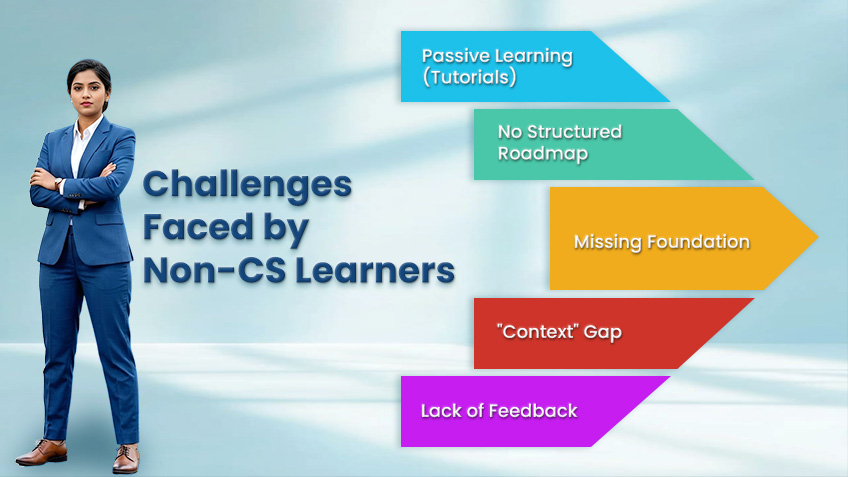
Many beginners watch hours of tutorials without actually typing any code. Remember, watching tutorials is easy, but it doesn’t mean you’re learning. Without practising, you are not building the skills to solve real problems, which is essential to secure a job today.
As there is too much information available on the internet, without a clear plan, it’s easy to jump from one topic to another without ever mastering one. Learning without a plan means spending time on things that don’t matter and missing the things that are actually important.
Non-CS learners often rush to learn popular tools or tech like AI before understanding the basics of how computers work. A lack of a solid base in any IT field will hold you back. Building a strong foundation early makes learning advanced tech much easier and faster.
Solving a classroom puzzle is easy, but solving a real business problem is complicated. Many self-taught learners struggle to see the “big picture,” like how code is tested or how to keep it safe from hackers. You need to move beyond simple practice and learn how real-world tech companies actually run their systems.
When you are learning alone without any guidance, it’s hard to know if your code is professional or not. If no one checks your work, you will not know that you are making mistakes until it’s too late. Getting feedback from an expert helps you write cleaner code and gives you the confidence to know you are truly ready to crack an IT interview.
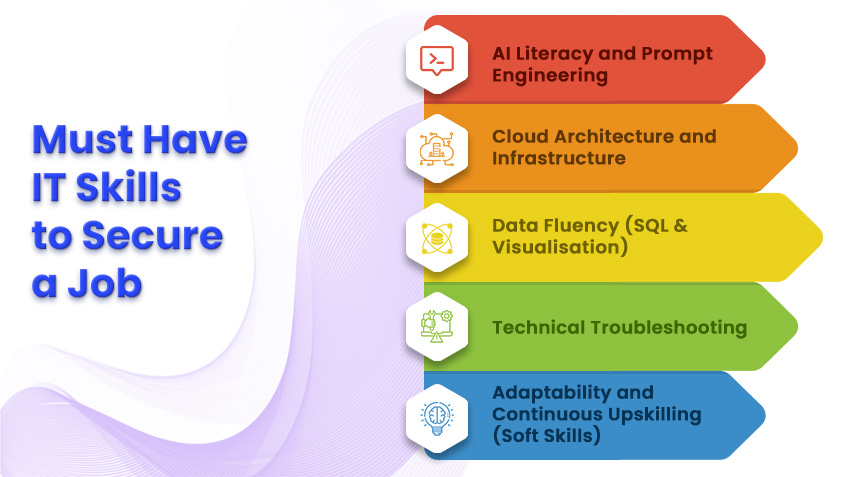
Here is a simple breakdown of the five essential pillars for landing a job in today’s market.
AI Literacy means knowing what AI can or cannot do safely. Here, prompt engineering is simply about giving an AI assistant clear, high-quality instructions. If you can talk to an AI and enable it to help you with writing code, drafting emails, or solving problems, you can do it much faster than a person who doesn’t know how to use it.
Today, everything is stored on a giant computer network, ‘The Cloud’, owned by companies like Amazon or Google. Understanding Cloud Architecture means knowing how these “digital warehouses” are set up and organised. It’s the skill of ensuring an app runs smoothly and securely on the internet.
Every business runs on data. Data Fluency is a skill that helps you read data. This includes learning SQL, which is just a language used to ask a database questions. Then, you use data visualisation tools like Tableau or Power BI to turn numbers into easy-to-read charts. It’s about turning a mess of data into a clear story that helps managers make decisions.
No matter how well things are built, they will break. Here, troubleshooting is the ability to stay calm, find where the error is, and identify a solution to fix it. You don’t need to know every answer; you just need to be a professional who knows how to use Google, AI, and logic to make things work smoothly again.
Being adaptable means you are willing to change how you work. Continuous upskilling means you always want to learn, whether by taking a short 6-month course or reading a blog to stay current. In 2026, the most valuable person isn’t the one who knows everything, but the one who learns new things faster.
The following table breaks down common IT and Tech roles that are accessible without a formal CS degree.
| IT/Tech Jobs Without a CS Degree | Key Skills/Tools | Core Responsibilities |
| Data Analyst | SQLTableau/Power BIExcelPython | Interprets data to help businesses make decisions. |
| UX/UI Designer | FigmaAdobe XDDesign ThinkingUser Research | Designs the look, feel, and flow of apps and websites. |
| Junior Data Scientist | Python (Pandas, Scikit-learn)StatisticsMachine Learning | Cleans data and builds predictive models to solve business problems. |
| Prompt Engineer | NLP basicsLogicCreative WritingAI Ethics | Optimises AI outputs by crafting precise instructions for LLMs. |
| Digital Marketer (Tech) | Google AdsAnalyticsContent Strategy | Manages SEO, ads, and data-driven marketing campaigns. |
| Cloud Support Associate | AWSAzureGCP basicsNetworking | Helps clients manage and troubleshoot cloud infrastructure. |
| Full Stack Developer | React/AngularNode.jsPythonSQL/NoSQL | Builds both the user-facing (front) and server-side (back) parts of an app. |
| QA / Software Tester | Manual TestingSeleniumJiraLogic | Finds bugs and ensures software quality before launch. |
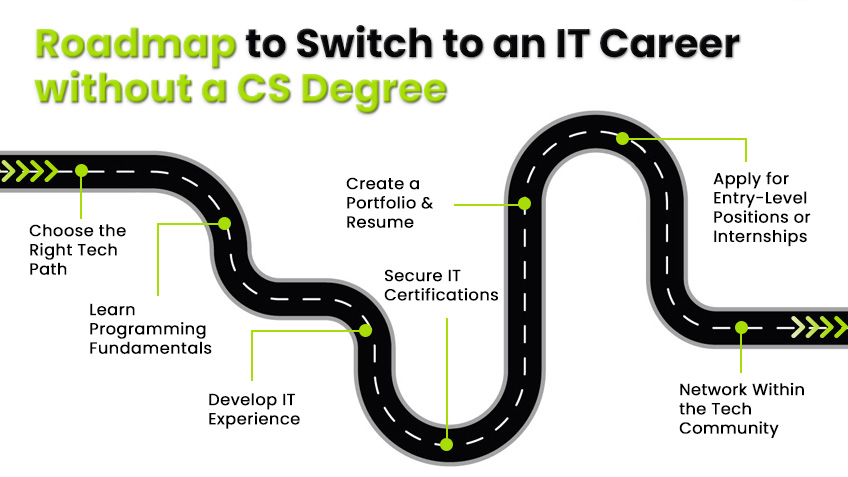
Here is the step-by-step guide to make an IT career switch without a computer science degree.
You need to pick the right IT career path to start your journey. For example, you can choose:
No matter what academic background you come from, you need to understand how computers think. While you don’t need to be a math genius, you do need to understand how data moves. Every tech path requires a foundation in logic.
For example, if you want to build a career in Data Science, focus on Python and libraries like Pandas. For full-stack developers, working with Vue.js or Angular requires mastering JavaScript, while working with MS ASP.NET Core requires a solid grasp of C#.
Experience isn’t what a 9-to-5 job adds to your resume; it’s about proof of your work. You can build a custom CRM using PHP/Laravel for a local business, or perform a deep-dive Data Analytics project on public health trends to showcase on your blog.
For instance, if you want to learn AI in Digital Marketing, consider running a small AI-driven ad campaign for a hobby project to show you can manage budgets and prompts.
Certifications add significant weight to your profile. At Karmick Institute, you can earn prestigious Vishlesan I-Hub, IIT Patna certification in your chosen tech field. This prestigious credential gives you the competitive edge needed to prove your skills in today’s competitive job market.
Whether you are mastering data science, data analytics, or digital marketing, an IIT Patna certification is highly regarded. Securing this industry-recognised certification can help you stand out in the pile of resumes.
Whether you choose to be a data scientist, full stack developer, or digital marketer, a strong portfolio of practical projects can turn your tech career dream into reality. A robust portfolio featuring links to live projects, functional repositories, or interactive dashboards that demonstrate your ability to deliver end-to-end solutions can greatly enhance your career prospects.
Once you choose your career path, gain experience, and consider applying for junior positions. For example, if you want to be a data scientist, start as a junior data analyst and look for junior web developer roles that focus on one side of the stack, if you are thinking of a career in full-stack.
Starting your career with junior roles allows you to gain professional experience, especially working within a larger team. You can also consider internships or apprenticeships, which help you learn a company’s unique workflow while you contribute value using your fresh expertise.
Networking is about building genuine relationships with professionals who are already established in your chosen tech field. You can join communities, attend events, and seminars where professionals showcase their latest projects.
When you reach out to anyone, ask specific questions about their technical workflows or how they integrate emerging tools like AI into their daily tasks to gain insider knowledge.
In this blog post, we introduced practical steps to take to switch to IT career and how a non-CS holder can also land a flourishing, high-paying tech role easily.
Now it is your turn to take the right step.
Enrol yourself in Karmick Institute’s structured, high-quality IT training that leads your path to success. Whether you are interested in data science, data analytics, or digital marketing and other fields, we offer top-notch, practical training with the prestigious Vishlesan I-Hub, IIT Patna certification to boost your career prospects.
With 100% placement assistance, we ensure that every student is prepared and lands his/her dream role after the course completion.
So, don’t get left behind!
Call us today: 9836423755 | 836423755 | 6289562294
Do I need a CS degree for IT job?
No, a Computer Science degree is not mandatory. Many employers now look for demonstrable skills, industry-recognised certifications, and a strong portfolio over a degree.
What are the available IT jobs for non CS degree holders?
Many IT jobs are available to non-CS graduates, including Full Stack Development, Data Analytics, and UI/UX Design. You can also find great opportunities in Digital Marketing, Data Science, and Web Design, where your unique background and practical skills often matter more than a specific degree.
Is IT possible to get an IT job without a degree?
Absolutely! Many top IT companies hire people in Full Stack development and UI/UX based on their certifications and impactful portfolio rather than their degree.
What are the highest-paying tech jobs without a degree?
The highest-paying jobs without a degree include data science, full stack web development, and cloud architecture. Additionally, specialised positions in digital marketing and UI/UX design also help you command a high salary range as companies now prefer technical skill sets and verified certifications over traditional degrees.
Is it really possible to switch to IT career from a completely different background?
Absolutely! Many successful professionals transition from fields like sales, healthcare, or teaching with the help of skills like problem-solving and communication, alongside technical training.
Is starting a tech career with no experience easier?
Yes starting a career in IT with no experience is easy now due to the rise of AI tools that enable beginners to build complex projects within a few minutes.
How can non-CS graduates break into tech in 2026?
You can break into tech by gaining a high-quality certification like IIT Patna, building a strong portfolio of work, and networking within professional communities. Also, staying updated on AI integration will give you a significant advantage.
What are the best tech roles for non-CS graduates?
With their problem-solving and creative skills, non-CS graduates excel in Data Science, UI/UX Design, and Digital Marketing.
How long does it take to switch to IT career?
The timeline depends on your grasping ability and skills. Most learners can make a successful transition to IT in 6 to 12 months.
Which tech role is best for a non-CS background?
Roles that align with your existing soft skills, with technical training, are ideal for you. For instance, data analytics is good for those with an analytical mind, digital marketing and UI/UX are perfect for creative people.
Which IT jobs require a computer science degree?
Roles that are highly theoretical require a computer science degree, such as Machine Learning research, Hardware Engineering and Operating System development. However, application roles like web design and full stack development require skills and portfolios over any degree.

Soumya Naskar is an expert MERN Stack development instructor. With many years of experience in the field, he provides learners with practical and project-based training that builds job-ready skills, leading to a successful tech career.


 Login
Login