info@karmickinstitute.com
 +919836423755
  +919836423755
Get up to 25% OFF on all IT courses Enrol Now Only 20 Slots Remaining! Limited Time Offer!

With the global market projected to hit $924 billion by 2032 and analyst roles surging 25% faster than other occupations, learning data analytics can undeniably lead you to an in-demand, high-paying path in 2026 and beyond.
Most people think that the data analytics field is just for computer science graduates or math geniuses: it is not. Today, data analytics is more accessible, practical, and relevant across various industries than ever before.
Whether you have been thinking about upskilling or seeking a career in data analytics, this is the right time to be on this path and earn a 6-figure salary through the best data analytics courses.
If you are still in doubt, this guide will help you understand why you should learn data analytics and start a career in this field. Explore why it is the right career move and how to get started in 2026.
Let’s dive in!
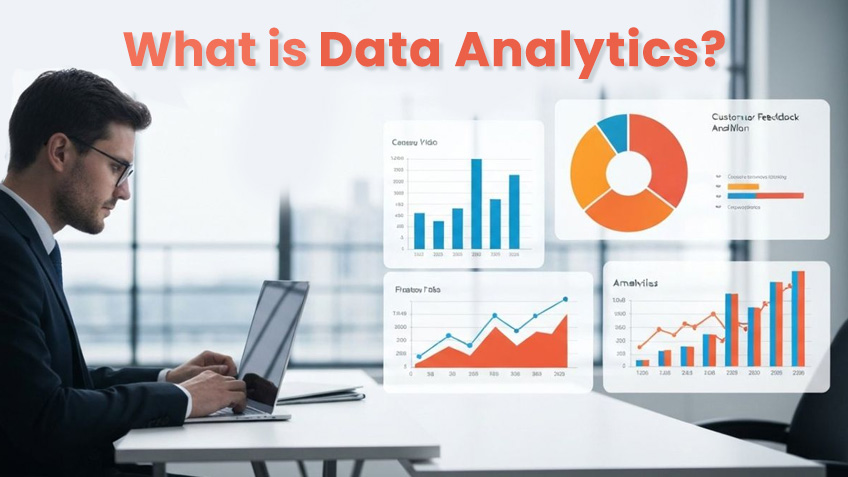
Data analytics is the process of looking at the raw dataset and figuring out what it is trying to tell you. Simply put, it’s the process of collecting, organising, and studying data to understand what happened, why it happened, and what should happen next.
Data analysts collect the data, analyse it, and leverage the insights to make better decisions.
For example, as a data analyst, you will solve business problems like “Why are sales decreasing in a particular region? Which marketing campaign is actually working and bringing in customers? What’s likely to happen next quarter if current trends continue?”
The data analyst salary in India depends on your experience, where you work, and the industry you’re in. Here’s a full breakdown across all three.
| Experience-Level | Average Salary in India | Top Industries Hiring |
| Entry Level | ₹4L – ₹6L | IT, Retail, BFSI (Banking, Financial Services, and Insurance) |
| Mid Level | ₹7L – ₹10L | E-commerce, Healthcare, SaaS |
| Senior Level | ₹10L – ₹20L | Tech, Finance, Consulting |
| Lead / Manager | ₹30L – ₹50L+ | FAANG (Facebook (Meta), Amazon, Apple, Netflix, Google), Investment Banks, Startups |
| City | Average Annual Salary |
| Delhi / NCR | ₹7L – ₹18L |
| Mumbai | ₹8L – ₹22L |
| Bengaluru | ₹9L – ₹25L |
| Pune | ₹6L – ₹16L |
| Hyderabad | ₹7L – ₹20L |
| Chennai | ₹6L – ₹15L |
| Kolkata | ₹5L – ₹10L |
| Industry | Average Salary Range |
| IT / Tech & SaaS | ₹8L – ₹30L |
| BFSI (Banking & Finance) | ₹8L – ₹28L |
| E-commerce & Retail | ₹7L – ₹22L |
| Healthcare & Pharma | ₹6L – ₹18L |
| Consulting | ₹7L – ₹20L |
| Manufacturing / FMCG | ₹5L – ₹12L |
| EdTech | ₹5L – ₹14L |
Whether you are just starting your career or looking to get a quick promotion through upskilling, learning data analytics equips you with something most skills don’t have, i.e. relevance across every industry, every role, and every market condition.
Here’s why enroling in a data analytics course and building a career in this field is one of the smartest investments you can make in yourself right now:
Companies across the world are generating massive amounts of data, but the talent that can actually interpret it is significantly low. The screenshot below shows what the job market actually looked like for data analysts on LinkedIn in May 2026.

However, the number of applicants was considerably lower, which indicates the talent available (supply) is significantly lower than the demand for data analysts. Learning analytics can turn you into a valuable asset that companies are hiring for.
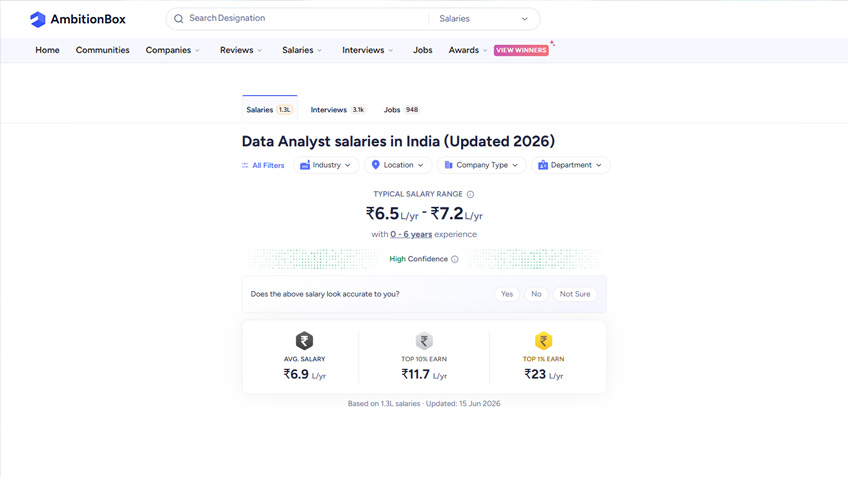
Data analytics is one of the few skill sets where your pay scale grows rapidly with experience. The screenshot below (Ambition Box) highlights that the average data analytics salary in India is ₹6.9L per year. But the top 10% of analysts earn ₹11.6L per year, and the top 1% make as much as ₹22.9L per year.
Whether you want to work in healthcare, e-commerce, finance, sports, education, or government, data analysts are required in every sector that runs on data now. Learning top data analytics tools equips you with the most sought-after skills that every industry hires for.
Watch the video below to see the top data analytics tools in action across these industries:
Yes, you can switch to this IT career without a CS degree. Through structured learning and hands-on practice, most people become job-ready within 6–12 months. The top data analytics tools that help you get started and land your first data analyst role are SQL and Excel, making it one of the top 6-month courses after graduation.
AI will not replace data analysts but will elevate their role. While AI handles the repetitive tasks like cleaning data, generating basic reports, data analysts now spend more time on interpretation, storytelling, and business strategy. This has made the data analyst job more interesting and more relevant.
Most data analytics work happens on a screen, looking at dashboards, writing queries, and building reports. This means you can work for a company in the US from Kolkata, take on freelance clients between jobs, or simply skip the commute altogether, making data analytics a flexible career path.
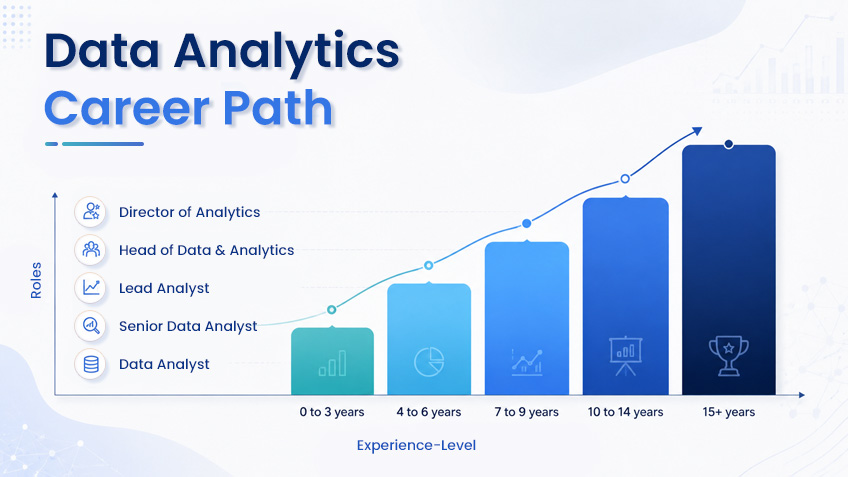
You begin as a data analyst, grow into a senior analyst by year four, and keep moving up to lead analyst, head of data & analytics, and eventually director of analytics. The path is straightforward, the roles are well-defined, and the salary growth is impressive at every stage.
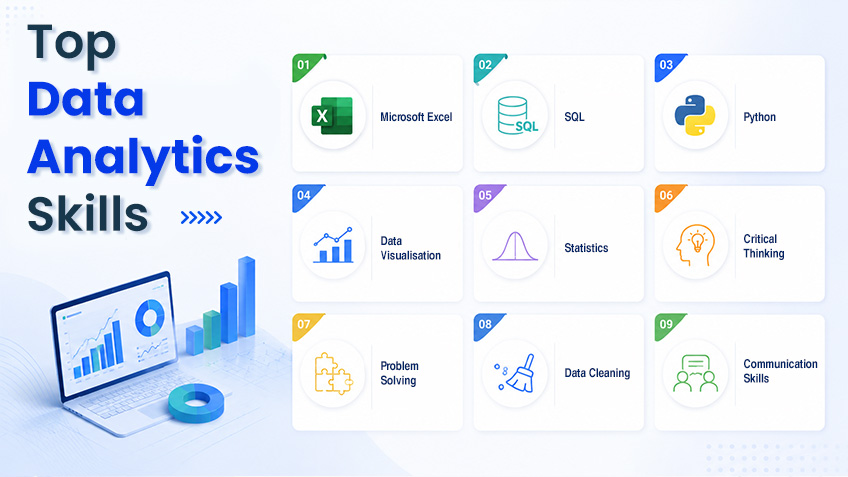
Here are some of the most essential data analytics skills to start a career in the field.
Excel remains one of the most used tools and also a starting point for most data analysts. From pivot tables and VLOOKUP to basic data cleaning and visualisation, it teaches the fundamentals of working with data in a structured way.
SQL is the backbone of data analytics. This data analytics tools helps you pull and filter data from databases, and almost every job listing asks for this skill.
Once you learn SQL and master it, Python helps in your career growth and takes you to the next level. It helps in handling bigger datasets, automating tasks, and doing deeper analysis with libraries like Pandas.
Tools like Tableau and Power BI help data analysts turn numbers into compelling charts and dashboards that non-technical people can easily understand.
You need to have a working understanding of concepts like mean, median, standard deviation, correlation, and probability to read data correctly and avoid incorrect conclusions.
These are arguably the most important soft skills for data analysts. Data professionals should know which questions to ask, which data to trust, and what the numbers actually matter for the business.
Real-world data is full of duplicates, missing values, and inconsistencies. Here, data cleaning is knowing how to fix duplicates, missing values, and errors before analysis.
Finding insights is a critical skill, but communicating the same to people who are not analysts is also very important. Being able to communicate your findings in simple language, both in writing and in presentations, is what makes you a valuable data analyst to any company.
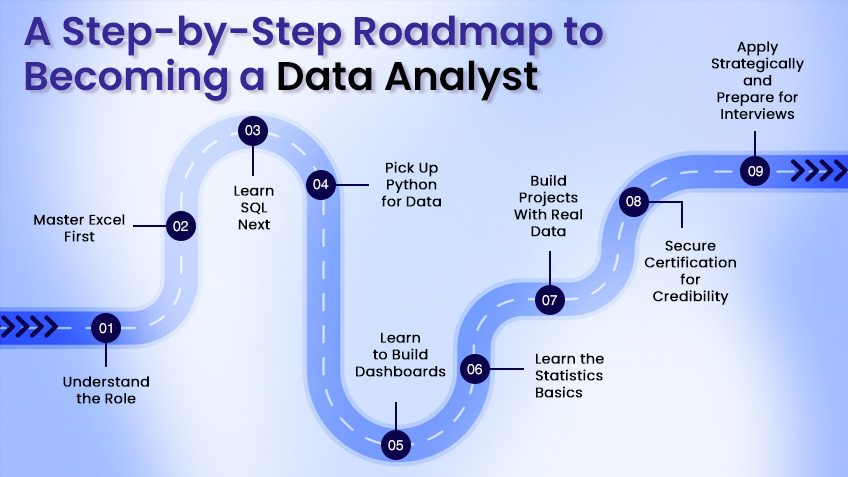
The good news is that you don’t need a four-year degree or a background in statistics to get started. With focused learning and following the roadmap below, most people can become job-ready within 6 to 12 months.
Before you start learning, spend two weeks understanding what data analysts actually do. You can read job descriptions, watch YouTube videos, and get a clear picture of the role. It makes everything you learn feel relevant.
Excel is the most beginner-friendly way to start working with data. It teaches you how to think and work with data in rows, columns, and formulas, which is the foundation of everything else.
SQL is the single most demanded skill in data analyst job postings. This tool helps you pull data from databases: filtering, grouping, joining tables, and sorting results.
You don’t need to learn the entire Python language. Consider focusing specifically on Pandas for working with data and Matplotlib for visualising it.
Power BI and Tableau are the two most in-demand visualisation tools in India right now. Pick one and learn how to connect data sources, create charts, and build a clean dashboard.
You don’t need to go deep into statistics, just learn enough to understand mean, median, standard deviation, basic probability, and correlation to interpret data correctly and spot misleading numbers.
Build end-to-end projects around the topics you have more interest in (sports, finance, e-commerce, etc). Each project should tell what problem you looked at, what the data revealed, and what you recommended based on your findings.
The right data analytics certification shows employers you’ve been trained seriously and not just self-taught through YouTube videos. Karmick Institute’s Data Analytics with AI course is one of the most comprehensive options that covers everything from SQL and Python to AI-powered analytics tools in a structured, industry-aligned curriculum with Vishlesan I-Hub, IIT Patna and 100% placement support.
Don’t apply to several jobs randomly; focus on roles that match 70% of the requirements of your current skill level. Most entry-level interviews test how you think, not just what you know, so stay curious, stay updated, and back every answer with an example.
Data analytics is a skill that is only becoming more valuable with time. Whether you are a fresh graduate, a working professional looking to switch, or someone who simply wants to future-proof their career, the path is clearer and more accessible than ever before.
The best part is, you do not need a degree, a technical background, or years of preparation to enter this field. You just need the right guidance, the willingness to start, and the best data analyst course training to get started/
If you are ready to take that first step, our Data Analytics course with Vishlesan I-Hub, IIT Patna certification gives you everything you need to launch a high-paying career in this domain. We are among the best IT training institutes in Kolkata, offering job-focused data analyst training with 100% placement assistance.

Should I learn data analysis in 2026?
Yes, demand for data skills is growing across every industry, and most people can acquire these high-paying skills in 6 to 12 months without a technical degree or prior experience.
What do you need to learn for data analysis in 2026?
In data analysis, start with Excel and SQL first, move to Python basics next, and learn how to build dashboards in Power BI or Tableau. After this, get foundational knowledge of statistics to read data correctly.
Is data analytics still in demand in 2026?
Absolutely! The global data analytics market is set to cross $924 billion by 2032, and these skills consistently rank among the top 10 in-demand IT skills.
Why is the data analyst career path growing?
From tracking sales to understanding customer behaviour to making product decisions, every business today runs on data. This has surged the demand for data analysts as they can collect, clean, and interpret that data and help businesses make profitable decisions.
What is the salary of a data analyst in 2026?
The average data analytics salary in India is ₹6.9L per year. However, the top 10% of analysts earn ₹11.6L per year, and the top 1% make as much as ₹22.9L per year.
Will AI replace data analysts?
No, AI will not replace data analysts. Rather, AI handles repetitive tasks like data cleaning and basic reporting, which allows analysts to focus on interpretation, strategy, and decision-making.
What are the top 3 skills for a data analyst?
The top 3 skills for a data analyst include SQL for querying and managing data, Excel or Python for analysis and automation, and a visualisation tool like Power BI or Tableau for presenting insights clearly.
Why should I learn data analytics in 2026?
You should consider learning data analytics in 2026, as these skills are now relevant in every industry, not just tech. Knowing how to work with data makes you more employable, secures high-paying opportunities, and future-proofs your job.
Can I learn data analytics without a tech background?
Absolutely. Many successful analysts come from non-technical fields like commerce, humanities, or business. Many data analytics tools, including Excel, SQL, and Power BI, are designed to be learned without any coding experience through the best course for data analytics.
What is the future scope of data analytics?
The future scope of data analytics is bright and expanding. With AI, machine learning, and automation becoming part of everyday business operations, businesses need more analysts to interpret what these systems produce, identify opportunities, and guide smarter decisions at each stage.
How long will it take to learn data analytics?
Our data analytics with AI course is designed to transform you from a beginner to a job-ready data analyst in 6 months. Through practical training, a comprehensive curriculum, and 100% placement assistance, we ensure you face the interview with confidence and land your dream job right after the course completion.

Abhishek Ray is a data science educator who delivers results-driven training in AI and ML. With over 10 years of experience, he helps aspiring data scientists master cutting-edge tools and techniques through hands-on learning and valuable insights.


 Login
Login